Rohrnudeln (can you say that?)- - Bavarian Hot Cross Buns
vote now

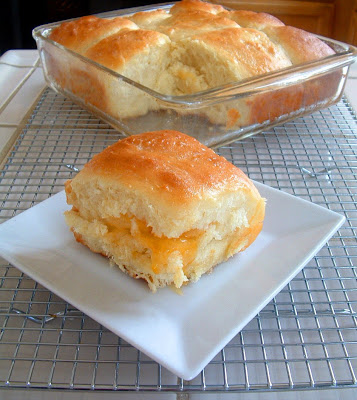 I've been seeing a lot of recipes for "Hot Cross Buns" all over Food Blosphere. I got to thinking-- my D.N.A. roots are deeply embedded in Germany-- Bavaria, to be specific. I saw a similarity to the sweet dough for Hot Cross Buns (an English Easter tradition) to a German sweet dough recipe. My mother's first cousin, Ursula, introduced me to her recipe for "Rohr Nudeln" a few years ago. I asked her for the recipe, which she gave to me from memory-- in metric measurements, no less.
 Whenever I bake these (and I'm getting better at it, each time), my boys are really happy. They love these, and I confess, so do I! I did my best to convert her measurements, and to apply her instructions--and then I tried to make these my own way. Here's how I made them:
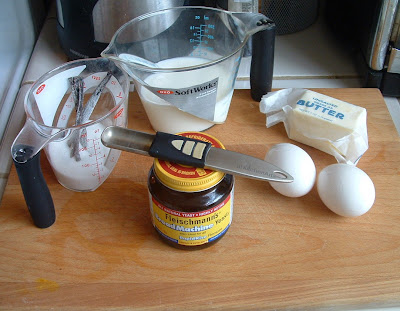 The ingredients are simple-- milk (I used 2%), butter (I used unsalted, this time), eggs, vanilla sugar (I make my own by sticking used vanilla beans in sugar, in a jar), yeast and flour. Oh, and jam of your choice. I had leftover peach jam from making Tyler Florence's Ribs Sauce.
 Tip: I soaked my eggs in a bowl of very warm water, to bring them to room temperature.
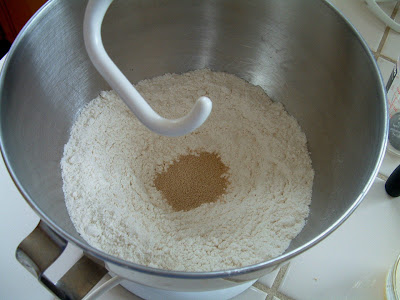 I decided to use my Kitchen Aid Stand Mixer. I used the dough hook, but later realized, it's best to start with the paddle to mix first (duh). Then, switch to the dough hook...
 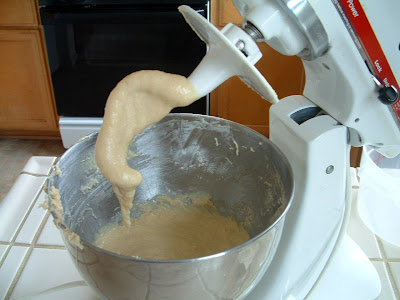 As you can see, the dough is not super thick, as in traditional bread dough. I mixed the dough for about 3-4 minutes. What's important, to me, is to have the milk and melted butter warm (about 105F) but not screaming hot-- I don't want to kill the yeast. I use Fleishman's Rapid Rise Yeast that I buy in a jar and keep in the fridge. It's never failed me.
 While the mixer is going, I turn my oven on to about 200F for a minute or two, then turn it off. I prefer to let my dough rise in the oven, free from drafts.
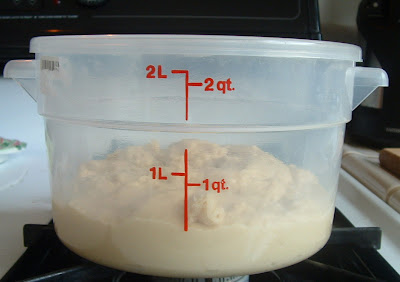 I just love my dough doubler. I bought it on the King Arthur Flour website. After setting this in my warm and cozy oven, I set the timer for 45 minutes...
 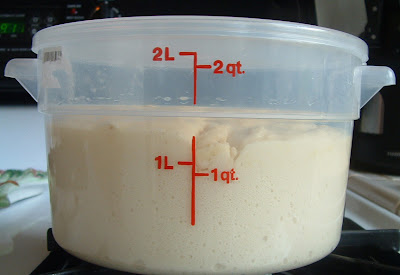 Yes!! I love working with yeast! Now, it's time to shape the rolls. Set extra flour right by you, because the dough can be sticky to work with:
 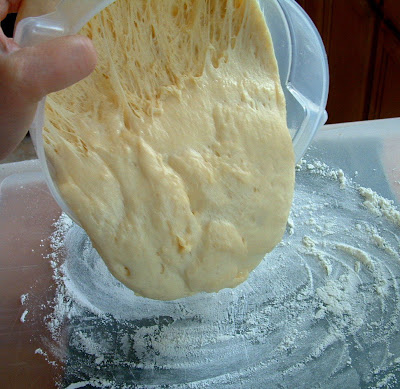 Now the real fun begins, because I'm still working on my technique for shaping rolls. Again, this dough is very soft to work with.
 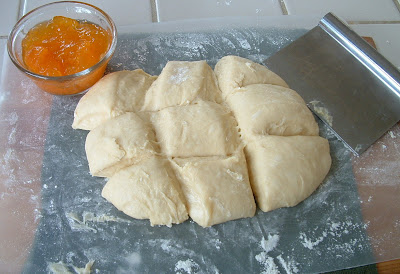 I added about 1/4 cup more of this flour to make it workable, gently folding and kneading with floured hands. Then I cut the dough into nine pieces. If you are afraid of butter, then cover your eyes.
 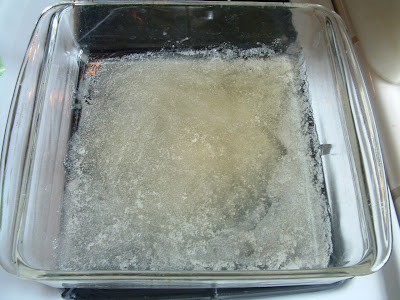 I melted 3 Tbsp of melted butter with about 1/4 cup of sugar and whisked it together, on the bottom of my baking dish. Now, it's time to shape the rolls, and set them into this buttery concoction...
 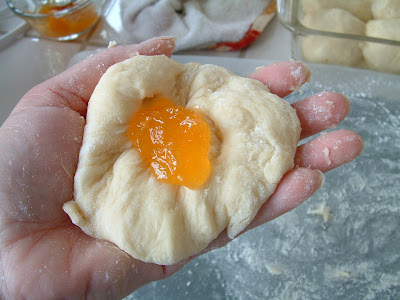 I flatten a piece, and put about 1 generous teaspoon of jam in the middle...
 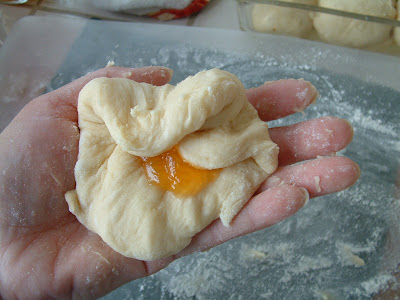 What work for me is to pull a corner of the dough, and then fold it over, and repeat this four times. Place these, seam side down, into the baking dish (with the melted butter & sugar).
 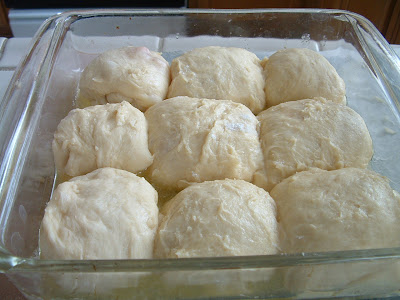 I am critical of my own work, so I noticed that my pieces weren't all even. That little one on the left? Mine! All mine! I covered the dough, and set my oven to 350F. Once the oven reached 350F, I popped the rolls into the oven for 30 minutes-- and cleaned up and ground my coffee beans.
  Hello, my pretties! I added a little more melted butter. Why not? Plus, it makes them photograph much better.
 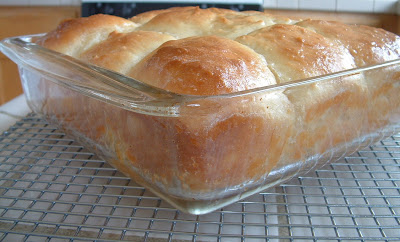 How long do you cool these? About 15 seconds! Believe me, these smell fantastic! The only crosses on these are the ones that I learned in Catholic School-- these are sinfully good. Forgive me. The melted butter and sugar gives a wonderful crust to these. Just enjoy them. There is no way to lighten these up, calorie wise.
 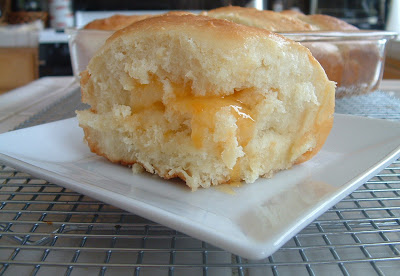 Baker's rights-- I get the first taste...
 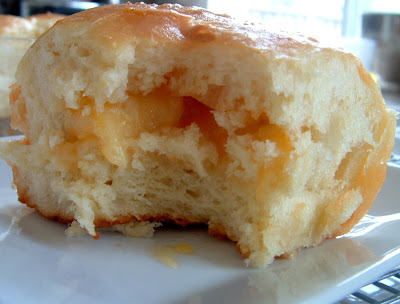 Ursula, I love you! I always have, since I was a baby...but this is wonderful!
 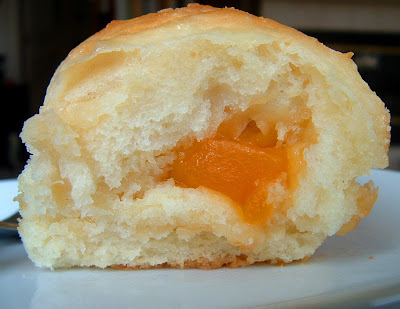 Unabashedly, I went in for that small piece...the one I said was mine. Oh, this was my SECOND helping.
 This Easter, I am remembering a time when my mother and I strolled through the streets of Bad Reichenhall and Salzburg Austria. The hand decorated Easter Eggs and the bakery and chocolatier displays are simply amazing. Easter has always been an important holiday for our family-- it makes me miss my mother.
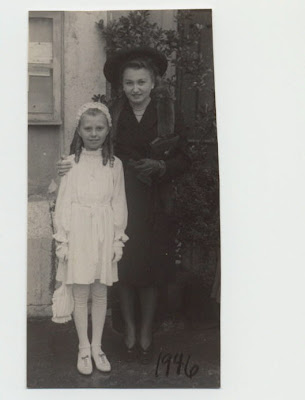 My mother (right) and her first cousin, Ursula, on her confirmation day, circa 1946.
 Blessed Easter to all of you!


A Feast for the Eyes
Comments