Agar-agar or gelatine: how do you convert without messing up your desserts?
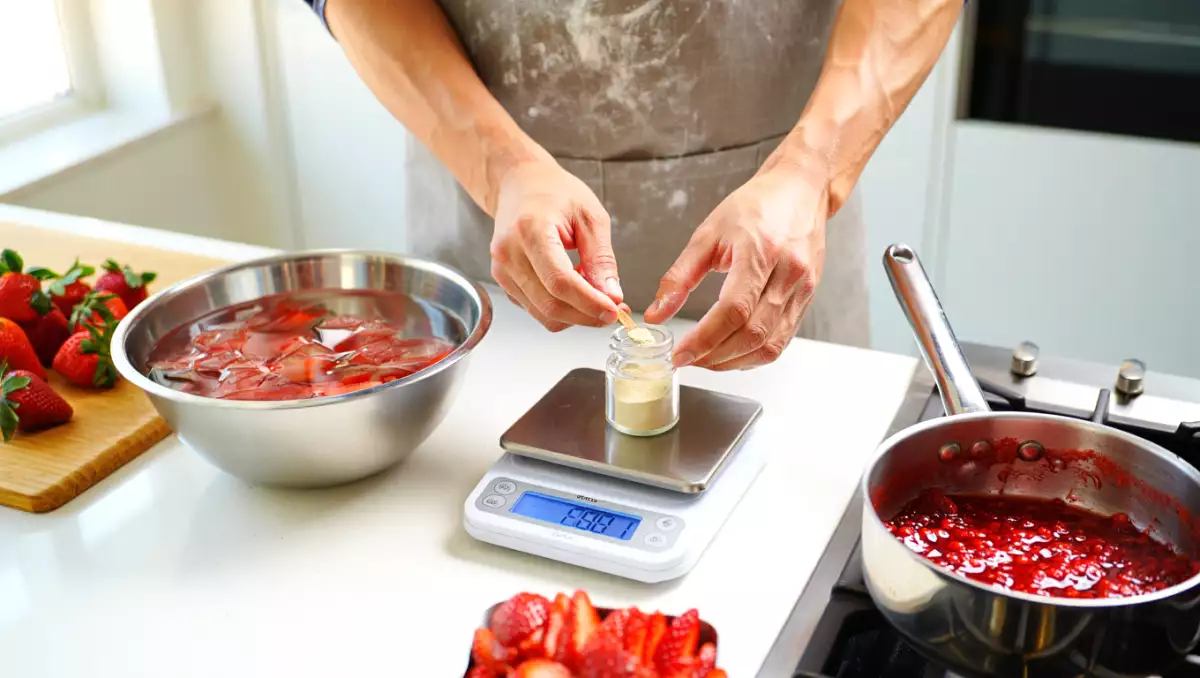
You've spotted the perfect recipe: panna cotta, entremets, mousse... everything's ready. But then you get stuck: it asks for gelatine... but you've got agar-agar in your cupboards. Or the other way round.
And inevitably, the question arises: can one be easily replaced by the other?
The answer is yes... but not just any old way.
Contrary to what you might think, these two gelling agents don't work in the same way at all. And the wrong conversion can completely change the texture of a dessert.
So how do you go about it without making a mistake? We explain.
Agar-agar vs gelatin: two products, two functions
Before we even talk about conversion, we need to understand one essential thing: agar-agar and gelatin do not act in the same way.
Gelatin is of animal origin. It comes in sheets or powder, and gives supple, melting, almost "trembling" textures.
Agar-agar, on the other hand, is a vegetable gelling agent derived from seaweed. It is much more powerful... and above all, it gives a firmer, cleaner texture.
It is this difference in texture that explains why conversions are not always 100% accurate.
The basic rule for converting
This is the key point to remember.
1 g agar-agar ≈ 2 g gelatin (about 1 sheet)
Or, put another way:
You need about 2 times as much gelatin as agar-agar.
For example:
2 g agar-agar ≈ 4 g gelatin
1 teaspoon agar-agar ≈ 4 to 5 sheets gelatin
Agar-agar is therefore much more powerful.
Why the difference?
Quite simply because agar-agar has a very high gelling power.
A small amount is enough to set a liquid, whereas gelatin requires more material to achieve the same result.
It's a concentrated gelling agent, but also more "rigid" in its rendering.
Please note: the texture will never be exactly the same.
This is THE point not to be overlooked.
Even with perfect conversion, the final result will be slightly different.
- gelatin gives a supple, melting texture
- agar-agar gives a firmer, almost brittle texture.
It's impossible to achieve exactly the same result with both.
This is particularly true of :
- mousses
- panna cotta
- entremets
How to use gelatine correctly
Gelatin requires special preparation.
It must be :
- soaked in cold water to soften
- then incorporated into a hot preparation
It must never be boiled, otherwise it loses its gelling power.
This is a common mistake, yet it can completely ruin a recipe.
How to use agar-agar
With agar-agar, it's the other way around.
It absolutely must be brought to the boil.
It's the heat that activates its gelling power.
The correct method :
- mix with a cold liquid
- bring to the boil for 1 to 2 minutes
- then leave to cool
As it cools, it gels.
The most common mistakes
When you're just starting out, there are some common mistakes you can make.
The first is to use agar-agar like gelatine. Without cooking, it won't work.
The second: getting the quantities wrong. Because it's so powerful, too much agar-agar can result in a texture that's too compact.
A dessert that's too "jelly-like" is often the sign of an overdose.
Can one be systematically replaced by the other?
In theory, yes. But in practice, it depends on the desired result.
For preparations such as :
- jellies
- jams
- jellied coulis
agar-agar works very well.
On the other hand, for very creamy or melting textures, gelatin is often more suitable.
The choice therefore also depends on the desired result.
A concrete example of conversion
You are making a panna cotta which requires 2 sheets of gelatine (approx. 4 g).
You want to use agar-agar.
You'll need around 2 g agar-agar (1 level teaspoon).
But be careful: the texture will be firmer than with gelatin.
The little tip that changes everything
If you use agar-agar, always start with a small amount.
It's better to adjust than to mess up the texture.
Because once the mixture has set, it's hard to go back.
 Adèle Peyches
Comments