Chocolate can transform a stew’s flavor... or turn it bitter and flat. Here’s how to get it right
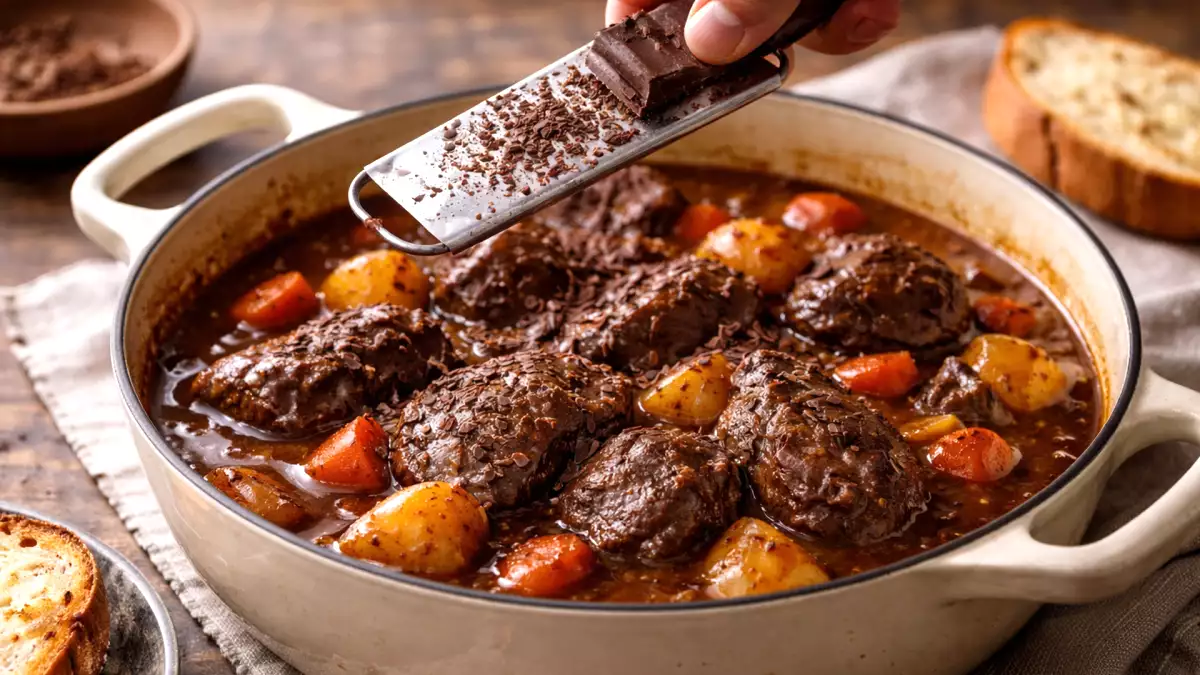
The first time someone tells you "put chocolate in the stew", your head does what any sensible head would do: it instinctively denies. Because chocolate lives in the territory of the sweet, of childhood recreation, of the obvious: the brownie or the birthday cake. And stew, a good stew, you relate it to something else: patience, poached onion, collagen that turns into density. Mixing them sounds like a joke. Like that strange fad of having oysters with Red Bull.
Until one day, out of sheer curiosity, you do it. Not a tablet, of course. A shy gesture: you take a slice. And then something happens that isn't magic, but it's close: the sauce doesn't taste like chocolate. It tastes more like itself. As if that stew had remembered a detail that I had forgotten halfway through cooking, and gained depth and flavor.
And then you understand: there are tricks that disguise flaws, that make up the final result. And there are tricks that refine. Dark chocolate, properly understood, belongs to the latter. The key is to understand what it brings and, above all, when to use it and when it is a mistake.
What chocolate does in a stew
Dark chocolate is a blend of cocoa solids and cocoa butter. The solids provide controlled bitterness and roasted notes; the butter provides a sensation of unctuousness. In a sauce with red wine, well-worked onion or a touch of tomato, this bitterness is not perceived as "bitter", but as depth: the sauce seems more serious, longer, with a cleaner finish.
In addition, cocoa has a natural affinity with "dark" flavors: honeyed meats, braised meats, warm spices. That's why it works so well in stews that already have that flavor direction.
When to do and when not to do
Adding chocolate works especially well if:
- Your stew has a dark base (red wine, beef broth, very poached onion, some tomato).
- You cook gelatinous cuts (cheeks, knuckle, tail, shank): the texture appreciates that silky point.
- There is a spicy touch (pepper, cloves, cumin, paprika...), even if it is discreet.
Not a good idea if:
- The casserole smells burnt. It is convenient to say it bluntly. Chocolate is not a lifesaver for a spoiled stew. Chocolate does not "fix" it: it underlines it. If the bottom is black, the wise thing to do is to strain the sauce and continue from a clean base.
- Your sauce is clear or delicate (white wine, citrus, fish stews). Here the cocoa adds a note that does not fit.
- You are looking for brightness and lightness; chocolate tends to take everything into a deeper register.
Which chocolate to use and in what quantity
Which chocolate to use
- Dark chocolate (70–85%) is your best bet.
- Choose a plain bar without added flavorings (no orange, strong vanilla, or fillings), as these can throw off the balance of the stew or sauce.
- Avoid milk chocolate. It adds extra sugar and dairy, which can make the sauce heavy, cloying, or oddly sweet.
- If chocolate feels intimidating, use unsweetened cocoa powder instead. Look for 100% cocoa (no sugar). It’s easier to dose little by little until you reach the flavor you like.
How much to use
Think of chocolate as a seasoning, not a main ingredient.
- For 500 ml (about 2 cups) of sauce: Start with 2–3 g of dark chocolate; basically a small shaving or flake, not a whole square.
- For 1 liter (about 4 cups) of sauce: 5–8 g is usually enough.
- If you’re using pure cocoa powder: Begin with about ¼ teaspoon for 500 ml (2 cups) of sauce.
The goal is simple: when you taste it, you should think “what a great sauce”, not “they added chocolate to this.”
When to add it and how to integrate it
Timing matters as much as quantity. Adding it at the end is essential: when the meat is tender and the sauce has found its consistency, reduced to your taste. Chocolate does not appreciate violent boiling or sudden reductions; it can become harsh, insistent, and drag the whole towards a bitterness that is not in our interest. For this reason, add the chopped chocolate (or cocoa powder) with the fire at a minimum, or better still, off the heat: it dissolves and integrates without imposing itself. Let stand for a couple of minutes. Taste. And taste again to adjust to your taste.
How to adjust the point?
The excess of chocolate is corrected as almost all excesses are corrected in a sauce: with a little stock and a gentle reduction, until it regains concentration. If it remains "flat", two or three drops of vinegar at the end will awaken the whole without turning it into a flash. And if what is lacking is roundness, a knob of butter restores the shine and that silkier texture that makes the sauce stick (well) to the meat.
Depth without prominence
Chocolate is to refine a sauce that is already going in the right direction, not to make up for serious errors. If the stew tastes burnt, first it is time to do the basics: transfer without scraping, strain, rebuild from a clean bottom. Only later - when the sauce makes sense again and what it lacks is not correction, but depth - does it make sense to resort to cocoa.
In its exact measure, dark chocolate works as a discreet tool: it does not enter the scene for you to identify it, but to make the whole seem sharper and longer, as if the stew had had a little more time to explain itself. It is a resource without vanity: it does not look for the "curious note", it looks for the good sauce. And that is its most useful paradox: the better it is used, the less noticeable it is. There, precisely there, lives its elegance.
 Patricia González
Comments