Why do some French chefs place a circle of parchment paper over the mushrooms?
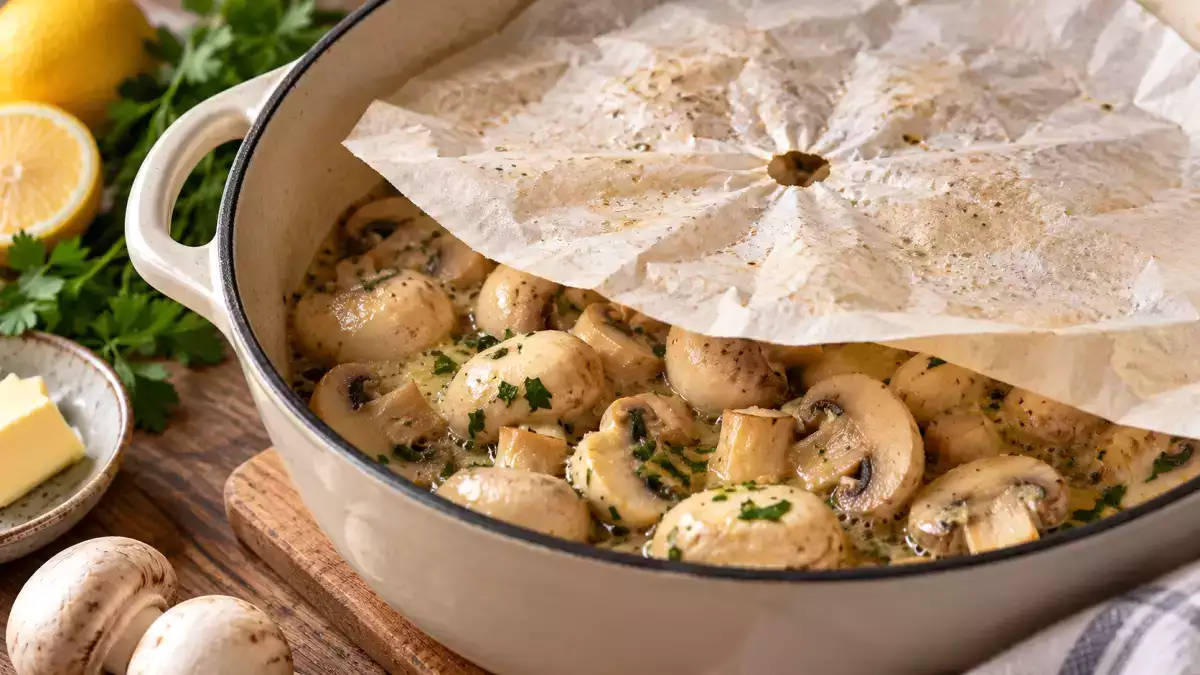
Mushrooms, butter, a few drops of lemon juice, a tiny bit of water, and, on top, a circle of parchment paper with a small hole in the center. At first glance, it doesn’t seem like there’s much technique involved. The paper, in fact, might give the impression of being a makeshift solution for a casserole dish without a lid.
But it’s not there by chance.
That disc has a name in classic French cuisine: cartouche. It’s still used and taught in professional culinary training. Placed directly over the food when cooking mushrooms, it helps control moisture and evaporation. In this case, it also has a very specific purpose: to cook them without achieving that golden brown color we usually associate with a good sauté.
Because we don’t always want to brown a mushroom.
That paper circle has a name: cartouche
In French cuisine, it is known as a “cartouche”: a disc of parchment paper cut to roughly the inner diameter of the pot and placed directly on top of the food, or very close to it.
Unlike a metal lid, it does not completely seal the pot. It retains some of the moisture around the mushrooms while allowing some steam to escape. In some versions, a central opening is cut out—a sort of chimney, a small vent for the steam.
It is a light covering that helps control evaporation without completely sealing off the cooking process. This method is also used to prepare certain vegetables and fruits. In the case of mushrooms, it is usually part of a very specific technique: the French method of cooking “à blanc.”
Poaching mushrooms "à blanc": what does the French technique "à blanc" mean?
The French name for this technique is “champignons cuits à blanc,” meaning “blanched mushrooms.” The goal is to produce tender, light-colored mushrooms without browning them.
It is not a forgotten tradition. The Académie de Versailles, in its professional culinary training materials, explains how to cook them for about five or six minutes in a pot of boiling water with salt, butter, and lemon, covered with parchment paper.
The classic preparation is usually made with common mushrooms, also known as Paris mushrooms. This doesn’t mean the method can only be used with them, but other mushrooms may have different textures and cooking times.
In a few sautéed mushrooms , we want the moisture to evaporate and the surface to reach a high enough temperature to brown; here, however, we maintain a moist cooking environment to achieve a light, tender, and juicy finish.
These are two valid ways to prepare the same ingredient, but with different results.
Lemon, butter, and very little water
The paper isn't the only factor: the lemon, butter, and amount of water also matter.
Traditionally, you start with a base of water, butter, salt, and lemon juice. There’s no need to fill the pot: the mushrooms themselves release water as they cook.
Lemon helps prevent browning. Mushrooms can take on brownish tones due to enzymatic reactions, and the acidity of the lemon juice helps slow them down. The effect depends, among other factors, on how much lemon juice is added and how the mushrooms are cooked.
The butter adds flavor and a creamier texture. The goal here isn’t to achieve the intense, toasty flavor of mushrooms sautéed over high heat, but rather a more delicate result.
What paper actually does
It’s worth clarifying what the paper actually does. It doesn’t seal the mushrooms or prevent them from releasing water. Its purpose is to help control what happens during cooking.
By sitting very close to the food, it reduces the mushrooms’ direct exposure to the air and helps retain moisture and cooking liquid around them. At the same time, it allows some steam to escape—especially if it has an opening—so the casserole isn’t as tightly sealed as it would be with a conventional lid, and evaporation can be better controlled.
This is useful because we start with very little water. As the mushrooms release their juices, these mix with the butter and lemon at the bottom of the pan.
Blanc cooking is a classic technique for preparing mushrooms as a side dish. It is used, for example, in French dishes such as blanquette or fricassée, but it can also be used for other preparations where you want to preserve their light color and tender texture.
How to prepare "À blanc" mushrooms at home
If you want to try this, clean the mushrooms and cut them into quarters or into thick pieces of similar size. Cut out a circle of parchment paper with a diameter slightly smaller than that of the casserole dish or deep skillet, so that it fits inside and can rest on top of the mushrooms. You can cut a small hole in the center, though this isn’t necessary.
Bring a small amount of water to a boil with butter, salt, and lemon juice. Add the mushrooms, place the parchment directly on top of them, and cook for about five minutes, adjusting the time based on their size and checking to make sure they’re tender.
Don’t try to brown them: the goal is for them to be cooked through, juicy, and pale in color. If you’re setting them aside to add to another dish later, store them with some of their cooking liquid—this will minimize their exposure to air and reduce the risk of them turning brown. If you’re not going to use them right away, cool them quickly and store them in the refrigerator.
What about the hole in the middle?
It’s probably the detail that stands out the most when we see this technique for the first time.
Not all cartouches have a hole, nor do all professional recipes require one. It’s a variation, not an essential requirement.
When there is a hole, it acts as a small vent for steam, a sort of chimney. The goal is to cover the mushrooms tightly, but without exactly replicating the enclosed environment of a conventional tapa.
More important than measuring the hole is cutting the paper properly so that it rests on the mushrooms and doesn’t hang over the edge of the pan. This will prevent the edges from coming too close to the flame or another direct heat source, especially if you’re cooking with gas.
A classic technique that still makes sense
French cuisine has long used butter and lemon to gently cook mushrooms. The cartouche serves the same purpose: to preserve the color and moisture rather than always aiming for a browned finish.
We’ve grown accustomed to hearing that to cook mushrooms well, you need to use a very hot skillet, not overcrowd it, and wait for them to brown. And that’s good advice when we want sautéed mushrooms.
But a blanquette, a fricassée, or a classic side dish may call for something else: pale, tender, and delicate mushrooms.
That’s where the cartouche comes in.
Not to correct poor cooking, but to deliberately achieve a different result.
 Patricia González
Comments