Forgot to thaw your chicken? These 3 safe methods can save dinner without risking food poisoning
Sunday 22 November 2026 21:00 - Juliette Hess
Your first instinct might be to leave it on the countertop or put it in warm water to speed things up. But that's exactly where a simple dinner mistake can become a food-safety problem.
According to the USDA, there are three safe ways to defrost chicken: in the refrigerator, in cold water or in the microwave. Each has advantages, and choosing the right one depends on how much time you have.
Here's how to save dinner without taking unnecessary risks.
The refrigerator method: the safest choice when you can plan ahead
Usually 1–2 days, depending on size.
If you have enough time, thawing chicken in the refrigerator is the best all-round method. The chicken stays cold throughout the process, limiting the conditions in which harmful bacteria can multiply.
Place the frozen chicken in a leakproof container or on a rimmed tray, then put it on the bottom shelf of your refrigerator. This prevents raw juices from dripping onto other foods.
Keep the fridge at 40°F (4°C) or below. A small package of chicken breasts may take around a day, while larger packages and whole chickens can take longer.
Once thawed, raw chicken can generally remain refrigerated for another one to two days before cooking. It can also be refrozen without cooking first if it has been handled safely, although its texture may suffer.
The cold-water method: when dinner is only a few hours away
Approximately 1 hour for 1 lb (450 g) of boneless chicken.
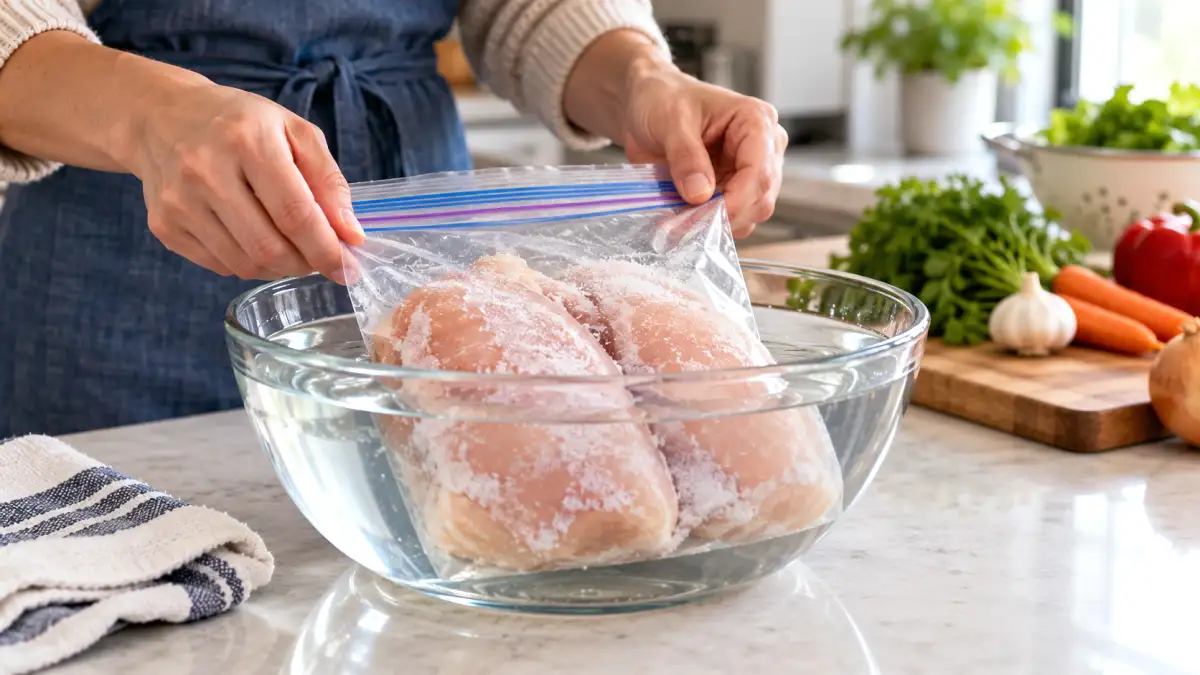
Forgot to move the chicken to the fridge this morning? Cold-water thawing is a practical alternative and can be considerably faster than refrigerator thawing.
1. Place the chicken in a securely sealed, leakproof food-safe bag.
2. Submerge it completely in a bowl of cold tap water.
3. Change the water every 30 minutes to maintain a cold temperature.
4. Cook the chicken immediately once it is fully thawed.
Never use hot or warm water. It may warm the outer layers of the chicken while the centre remains frozen.
A small package of boneless chicken breasts may thaw in an hour or less, while larger packages can take two to three hours or longer.
The microwave method: your last-minute dinner rescue
Usually minutes, depending on size and microwave power.
If you're already preparing dinner, the microwave is generally the fastest way to defrost chicken.
Remove any packaging that isn't microwave-safe, place the chicken on a suitable dish and use your microwave's defrost setting according to the manufacturer's instructions.
Check the chicken regularly and separate individual pieces when possible to encourage even thawing.
There's one essential rule: cook microwave-thawed chicken immediately.
Microwaves can heat some sections enough to begin cooking them while other sections remain frozen. Leaving partially warmed chicken sitting around gives bacteria an opportunity to multiply.
Why leaving chicken on the countertop is a bad idea
Thawing chicken at room temperature may seem harmless, especially when the middle still feels frozen.
But the outside can warm much faster than the centre.
The USDA identifies the temperature range between 40°F and 140°F (4°C to 60°C) as the bacterial danger zone, where bacteria can multiply rapidly.
Chicken should never be deliberately defrosted on the kitchen counter, even if it is still in its original packaging.
Perishable foods should not remain at room temperature for more than two hours, or one hour when the ambient temperature exceeds 90°F (32°C). These limits are not recommended thawing times.
Can you cook chicken directly from frozen?
Here's something many home cooks don't realise: you don't always have to thaw chicken before cooking it.
The USDA says frozen chicken can be cooked directly in the oven or on the stovetop, although the cooking time may be approximately 50% longer than for thawed chicken.
For example, a recipe that normally takes 30 minutes might require around 45 minutes, but that's only a rough planning estimate.
What really matters is the internal temperature: all chicken must reach 165°F (74°C), measured with a food thermometer in the thickest part.
Avoid cooking frozen chicken in a slow cooker, and don't attempt to fully cook raw frozen chicken in the microwave unless you're following validated product-specific cooking instructions.
Five mistakes to avoid when defrosting chicken
Using hot water: the outer surface can warm before the inside has thawed.
Leaving chicken on the counter overnight: the surface may spend too long at unsafe temperatures.
Thawing chicken directly in sink water: use a clean container and a leakproof bag to prevent contamination.
Putting microwave-thawed chicken back in the fridge uncooked: cook it immediately instead.
Refreezing chicken thawed in cold water without cooking it: poultry defrosted this way should be cooked before refreezing.
Which thawing method should you choose?
Cooking tomorrow: Refrigerator.
Cooking in 1–3 hours: Cold water, for suitable package sizes.
Cooking immediately: Microwave.
No time to thaw: Cook from frozen using a suitable oven or stovetop method.
The most important difference: refrigerator-thawed chicken offers some flexibility, whereas chicken thawed in cold water or the microwave should be cooked immediately.
How to avoid this problem next time
A little freezer organisation can save a lot of last-minute stress.
Freeze chicken in individual portions instead of one large block. Smaller, flatter packages generally thaw more quickly and evenly.
Write the freezing date on each package and plan tomorrow's meal before going to bed.
You can also keep a few recipes suitable for cooking directly from frozen, provided the cooking method ensures the chicken reaches a safe temperature throughout.
Frequently asked questions
Can I leave frozen chicken out for two hours to thaw?
No. The two-hour limit for perishable food at room temperature does not make countertop thawing a recommended method.
Can I thaw chicken in warm water?
No. Use cold water, a leakproof bag and change the water every 30 minutes.
How long does it take to thaw chicken in the fridge?
Many packages require around 24 hours, while larger cuts and whole chickens can take longer.
Can I refreeze chicken after defrosting it?
If it was safely thawed in the refrigerator, generally yes. If thawed in cold water or the microwave, cook it before refreezing.
Is it safe to cook chicken that is still partly frozen?
Yes, with an appropriate oven or stovetop method, enough cooking time and a food thermometer confirming 165°F (74°C) throughout.
Should I wash chicken after defrosting it?
No. Washing raw chicken can spread bacteria through splashes around the sink and nearby work surfaces.
The bottom line: dinner can still be saved
Forgetting to thaw chicken is frustrating, but it doesn't have to ruin your meal.
The refrigerator is your best option when you can plan ahead. Cold water is useful when you have a little time, and the microwave is the fastest option when dinner can't wait.
Whatever method you choose, avoid countertop thawing and check that the chicken reaches 165°F (74°C) before serving.
Sometimes, the easiest way to rescue dinner is simply knowing which shortcuts are safe.

Growing up in her family’s restaurant inspired Juliette’s love of cooking. Since 2017, she has developed, photographed and filmed recipes for Petitchef. Trained in visual imagery and lighting, she loves exploring world cuisines, particularly Asian food.
Comments