Keep baking fun: simplify fresh to dry yeast conversion with this easy method
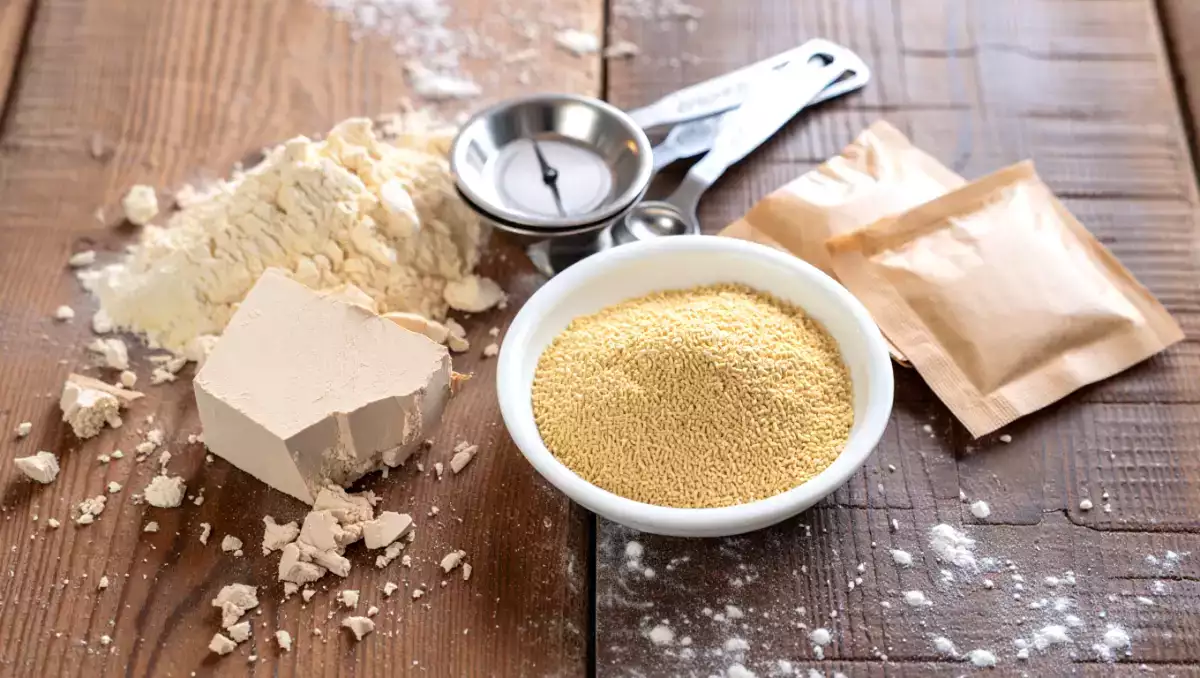
You’ve got a recipe in front of you, you’re ready to start baking… and then you hit a small problem: it calls for fresh yeast, but all you have in the pantry is dry yeast. Or the other way around.
And naturally, the same question comes up every time: how do you convert it correctly?
Because in baking, proportions matter. Too little yeast, and your dough barely rises. Too much, and the flavor can become overly yeasty and unpleasant.
The good news? The conversion is actually pretty simple… as long as you know the right ratio.
Fresh yeast vs. dry yeast: what’s the difference?
Before talking about conversions, it helps to understand what separates these two types of yeast.
Fresh yeast (also called cake yeast or baker’s yeast) usually comes in small refrigerated blocks or cubes. It’s soft, crumbly and moist, which means it has to stay refrigerated and doesn’t last very long.
Dry yeast, on the other hand, has been dehydrated. It comes in granules or packets and can be stored at room temperature for months.
The main difference comes down to concentration.
Because dry yeast contains very little water, it’s much more concentrated in active yeast cells. That’s why you need less of it.
The simple conversion rule to remember
This is the key ratio:
You generally need about 3 times less dry yeast than fresh yeast.
In practical terms:
- 1 ounce fresh yeast ≈ 0.35 ounce dry yeast
- 0.75 ounce fresh yeast ≈ 0.25 ounce dry yeast
- 1 standard packet of dry yeast (0.25 oz or 7 g) replaces about 0.75 oz (21 g) of fresh yeast
So if a recipe calls for fresh yeast and you only have dry yeast, simply divide the amount by three.
Why do you use less dry yeast?
Because dry yeast is concentrated.
When the water is removed, what remains are the active microorganisms responsible for fermentation. You end up with less volume, but almost the same effectiveness.
Smaller quantity, same job.
Not all dry yeast is the same
Here’s an important detail many people overlook: there are actually different kinds of dry yeast.
The two main types are:
- Active dry yeast
- Instant yeast
Active dry yeast usually needs to be dissolved in warm liquid before using.
Instant yeast can typically be mixed directly into the flour.
The easiest thing to do is always check the instructions on the package.
It avoids a lot of frustration later.
How to use fresh yeast properly
Fresh yeast requires a little more handling, but many bakers still love it for breads, pizza dough and brioche.
The basic method:
- crumble the yeast
- dissolve it in warm water or milk
Temperature matters a lot here.
Liquid that’s too hot can kill the yeast completely.
Ideally, the liquid should be around 77–86°F (25–30°C).
Using dry yeast is usually simpler
Dry yeast is often the easiest everyday option.
Depending on the type:
- either mix it directly into the flour
- or dissolve it in warm liquid first
It’s practical, stable and lasts much longer than fresh yeast.
That’s one reason it has become so popular in home baking.
The most common mistakes to avoid
One of the biggest beginner mistakes is using the same amount of dry yeast as fresh yeast.
That creates an over-fermented dough with an unpleasant flavor and texture.
Another common problem: liquid that’s too hot.
Heat can destroy the yeast before the dough even has a chance to rise.
And finally, avoid putting yeast directly against salt. Salt can slow down or inhibit yeast activity.
Can you always substitute one for the other?
Most of the time, yes.
Bread, pizza dough, brioche, cinnamon rolls, sandwich bread… fresh and dry yeast are generally interchangeable as long as you adjust the quantities properly.
Some bakers feel fresh yeast gives a slightly more traditional flavor, especially in slow-risen doughs. But in many recipes, the difference is fairly subtle.
The real secret to successful dough
Yeast matters… but it’s not the only thing.
Resting time is just as important.
A good rise allows the dough to:
- develop flavor
- improve texture
- become lighter and airier
And room temperature plays a role too. A cold kitchen naturally slows fermentation.
Sometimes, patience is just as important as the yeast itself.
A quick real-life example
Your brioche recipe calls for 0.7 oz (20 g) fresh yeast.
But you only have dry yeast.
In that case, use about 0.25 oz (7 g) dry yeast, which conveniently equals one standard packet in the U.S.
And you’re good to go.
Baking becomes much easier once you know the conversion
Whether you have fresh yeast or dry yeast on hand, adapting recipes is actually very straightforward once you know the ratio.
One simple conversion rule is enough to save your dough, avoid mistakes and make homemade bread, pizza or fluffy brioche with confidence.
Now all that’s left is to let the dough rise… and enjoy that incredible smell coming out of the oven ;)
 Adèle Peyches
Comments