How do you place your fork and knife on your plate? The message you send without realizing it
Wednesday 4 November 2026 21:00 - Francesco Rosso
It’s not always a matter of timing. In table manners, the placement of your cutlery on the plate is a subtle, silent language that helps convey whether you’re taking a break or have finished your meal. All it takes are two gestures, much simpler than they seem. And no, you don’t need to study a secret code to learn them.
What does the placement of cutlery on the plate really mean?
Let’s start with a funny misconception: the way you place your knife doesn’t reveal whether you’re an impatient, romantic, or particularly demanding person. At most, it reveals how far along you are in your meal. The language of tableware was created precisely to facilitate service without constantly interrupting the conversation.
There are two easily recognizable signals: “I’m still eating ” and “I’m done.” In a restaurant, these can help the staff understand when to approach you, but they don’t replace common sense: if the gesture is unclear, asking a question is still the best option.
There are two easily recognizable signals: “I’m still eating ” and “I’m done.” In a restaurant, these can help the staff understand when to approach you, but they don’t replace common sense: if the gesture is unclear, asking a question is still the best option.
How do you place your fork and knife when you take a break?
If you want to take a sip of water, answer a question, or enjoy the conversation, leave your fork and knife separated on the plate. The fork goes on the left, the knife on the right, with the tips pointing toward the center and the handles spread apart: the arrangement resembles an upside-down V.
In a traditional version of etiquette, the tines of the fork point downward and the blade of the knife points inward. Some describe this arrangement as resembling 8:20 on a clock. There’s no need to measure precisely: what matters is that the cutlery isn’t placed side by side as it is when you’ve finished eating, and above all, that it doesn’t touch the tablecloth.
In a traditional version of etiquette, the tines of the fork point downward and the blade of the knife points inward. Some describe this arrangement as resembling 8:20 on a clock. There’s no need to measure precisely: what matters is that the cutlery isn’t placed side by side as it is when you’ve finished eating, and above all, that it doesn’t touch the tablecloth.
Where do you put your cutlery when you're done eating?
Here, the etiquette changes. At the end of the meal, place your fork and knife parallel to each other, side by side, on your plate, with the handles facing you and the tips pointing upward. The knife goes to the right of the fork, with the blade facing the fork; the tines of the fork generally point upward.
You’ll see references to 6:30 or 4:20, these are different ways of describing a slightly angled arrangement. The key detail isn’t the perfect angle, but the two pieces of cutlery placed side by side. It’s the simplest signal to indicate that the plate can be cleared away, even if there are a few bites left.
You’ll see references to 6:30 or 4:20, these are different ways of describing a slightly angled arrangement. The key detail isn’t the perfect angle, but the two pieces of cutlery placed side by side. It’s the simplest signal to indicate that the plate can be cleared away, even if there are a few bites left.
Why shouldn't you place used cutlery on the tablecloth?
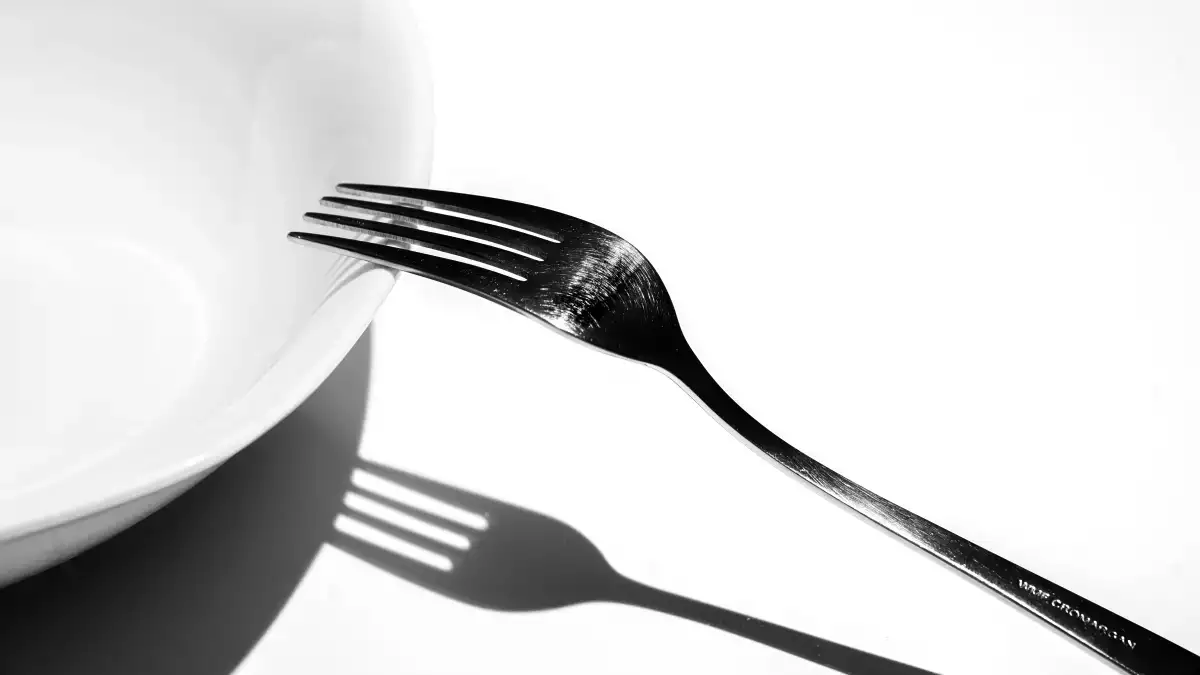
It’s one of those habits that seem harmless: the tip of the fork stays on the plate and the handle rests on the tablecloth, almost as if it were a small bridge. Yet table manners recommend avoiding this position.
Used cutlery can hold sauce, oil, or crumbs and stain the table surface or the napkin. Furthermore, a knife left lying across the plate is awkward to pick up during the meal. An easy rule to remember: once used, cutlery should remain entirely on the plate, both during breaks and when you’re finished.
Used cutlery can hold sauce, oil, or crumbs and stain the table surface or the napkin. Furthermore, a knife left lying across the plate is awkward to pick up during the meal. An easy rule to remember: once used, cutlery should remain entirely on the plate, both during breaks and when you’re finished.
Does having the cutlery crossed mean you didn't like the meal?
It is often said that crossed cutlery is a sign of disapproval toward the chef, while other combinations are said to mean “excellent” or “bring me the next course.” These interpretations appear in many illustrated guides, but they do not constitute a universally recognized code of etiquette.
In fact, according to various guidelines of Italian etiquette, it is preferable not to cross your fork and knife during a pause in eating. If a dish isn’t to your liking, don’t expect the server to figure it out from the arrangement on your plate: a polite and clear statement is much more helpful. And if the food is excellent? A compliment spoken in person is worth more than any arrangement of cutlery.
In fact, according to various guidelines of Italian etiquette, it is preferable not to cross your fork and knife during a pause in eating. If a dish isn’t to your liking, don’t expect the server to figure it out from the arrangement on your plate: a polite and clear statement is much more helpful. And if the food is excellent? A compliment spoken in person is worth more than any arrangement of cutlery.
Does the meaning of cutlery vary from country to country?
Table manners are not the same everywhere. The way you hold your fork, serving customs, and even the angle at which you tilt your fork to signal that the meal is over all vary. That’s why it’s best not to treat the “clock positions” as a universal rule.
What remains fairly intuitive, especially in Western dining contexts, is the distinction between placing cutlery separately during the meal and placing it parallel at the end. In a restaurant abroad, or when seated at a table with different customs, paying attention to the context matters more than a rule memorized by heart.
What remains fairly intuitive, especially in Western dining contexts, is the distinction between placing cutlery separately during the meal and placing it parallel at the end. In a restaurant abroad, or when seated at a table with different customs, paying attention to the context matters more than a rule memorized by heart.
What if you eat only with a fork or a spoon?
Not all dishes require both a knife and a fork. Think of risotto, a creamy soup, or a dessert: it would be odd to reach for a knife just to create the perfect arrangement!
If you’ve used only one piece of cutlery, at the end of the course, place it neatly inside the plate or bowl, without setting it back on the tablecloth. If, on the other hand, you’re just pausing for a moment, you can leave it resting inside without giving the impression that you’ve vacated your seat. If in doubt, simply say naturally, “I’m not finished yet, thank you.”
If you’ve used only one piece of cutlery, at the end of the course, place it neatly inside the plate or bowl, without setting it back on the tablecloth. If, on the other hand, you’re just pausing for a moment, you can leave it resting inside without giving the impression that you’ve vacated your seat. If in doubt, simply say naturally, “I’m not finished yet, thank you.”
How do you arrange your cutlery before you start eating?
There is one key difference that should not be confused: setting the table and placing cutlery after use are two distinct steps. At the start of the meal, the fork is placed to the left of the plate, and the knife to the right, with the blade facing the plate. If a spoon is to be used, it is usually placed to the right of the knife.
When there are multiple courses, start with the cutlery on the outside and work your way inward. Dessert cutlery may be placed horizontally across the plate. After the first bite, however, do not return the cutlery to its original position on the table: used cutlery remains on the plate.
When there are multiple courses, start with the cutlery on the outside and work your way inward. Dessert cutlery may be placed horizontally across the plate. After the first bite, however, do not return the cutlery to its original position on the table: used cutlery remains on the plate.
Three things to keep in mind at a restaurant
If all these details seem like a lot, just keep this tip in mind when reading and using tableware etiquette:
- Taking a break? Place the fork and knife separately, with the handles apart and the tips resting on the plate.
- Finished eating? Place them parallel and close together, resting completely on the plate.
- Want to express an opinion about the food? Say it politely: your cutlery isn’t a rating card.
 Francesco Rosso
A journalist in search of new horizons. As a lover of wine and simple dishes, I’ve decided to set out to discover new ways of approaching cuisine.
Comments