How to dress a salad in the right order? What to add first and why it keeps your greens crisp
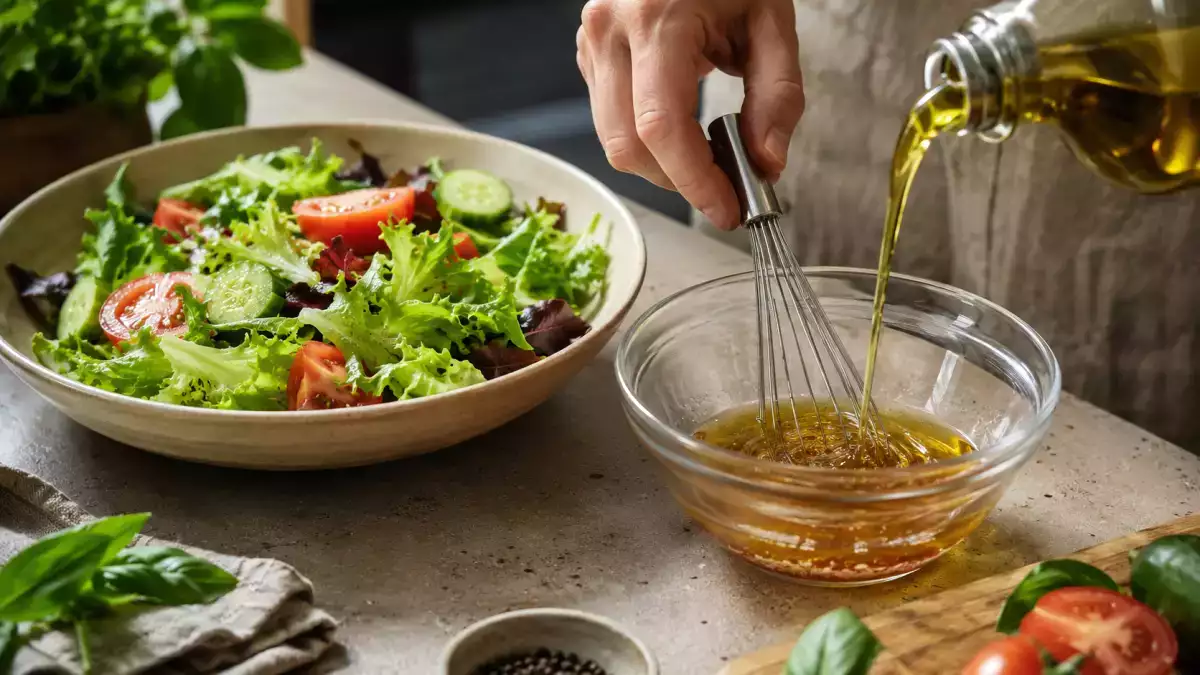
Dressing a salad is one of those everyday tasks that almost all of us do by heart. We add salt, oil, and vinegar in the order we’ve always seen at home—the one we learned from our parents—or simply the one that feels most natural to us. It seems like a trivial matter, but you only have to sit down at a table to discover that not everyone does it the same way: some start with salt, others add oil first to “protect” the leaves, and still others save the vinegar for last.
Is there really one order that’s better than the others? To answer that, we just need to look at how the ingredients behave: salt dissolves in vinegar or lemon juice, but not in oil; furthermore, oil and vinegar tend to separate. Understanding these properties allows us to explain the reasoning behind traditional methods and choose the simplest way to achieve a flavorful, balanced, and well-dressed salad.
So, what is the correct order for dressing a salad?
The short answer: Make the vinaigrette ahead of time
The easiest way to make a uniform dressing is to mix it separately:
- Pour the vinegar or lemon juice into a bowl or jar.
- Add the salt and stir until it dissolves.
- Add the oil and shake or whisk.
- Pour a small amount over the salad and toss.
- Taste it and adjust if necessary.
This prevents some leaves from getting too much oil, others too much vinegar, and others from being left with salt crystals.
If we want to sum it up in a formula, it would be this: acid and salt first; oil next; salad last.
Oil and vinegar: a pair that tends to separate
Vinegar is mainly composed of water, while oil is fat. These two liquids are immiscible: no matter how much we mix them together, they will eventually separate.
When we shake a vinaigrette, we temporarily break one of the liquids into very small droplets that become dispersed in the other. That’s an emulsion. Thanks to it, the dressing is distributed more evenly, and each bite contains a similar proportion of fat, acid, and salt.
The emulsion in a simple vinaigrette doesn’t last long. That’s okay, just shake it immediately before using it. If you want it to stay combined longer, you can add mustard or egg yolk, whose components help stabilize the droplets. Ingredients like honey also increase viscosity and delay separation, although their main function is to add sweetness and body.
Do you always have to use three parts oil to one part vinegar?
The well-known 3:1 ratio is a starting point, not a scientific law.
Not all vinegars have the same acidity, and we don’t all perceive flavors in the same way. Plus, the salad ingredients matter, too. Ripe tomatoes add moisture, acidity, and sweetness; arugula has bitter and spicy notes; cheese can add fat and salt; and olives are usually quite salty.
That’s why the most useful advice isn’t to stick to a specific ratio, but to taste as you go. It’s best to do this with a leaf or a small piece of one of the ingredients, because a spoonful of vinaigrette on its own will always seem more intense.
If it’s too acidic, you can add oil. If it tastes flat, it might need a little more salt or acidity.
Does the oil protect the leaves from the vinegar?
This explanation is very popular: the oil supposedly forms a waterproof film that prevents the acid from wilting the lettuce.
It’s a misleading oversimplification.
The oil does not create a perfect barrier around the leaves. Furthermore, it can seep into small irregularities on their surface and cause them to lose their firmness. In comparative culinary tests, leaves coated only with oil soften sooner than those treated with vinegar or water. A well-emulsified vinaigrette tends to perform better because it spreads evenly and prevents large accumulations of oil.
Therefore, adding oil first does not offer any special protection. It can even make it harder to distribute the vinegar and salt afterward.
Salt does draw out water, but it doesn't act like an instant vacuum cleaner
It’s also true that salt causes water to be drawn out of plant tissues through osmotic processes. This can be easily observed in cucumbers, tomatoes, zucchini, or cabbage that have been salted and left to sit.
But the effect depends on the amount, the food, and, above all, the time. A pinch of salt added seconds before eating doesn’t immediately turn lettuce into a soggy mess. The problem arises when we leave a dressed leafy salad to sit for quite some time.
That’s why the practical recommendation is simple: dress tender-leaf salads just before serving.
It’s also a good idea to dry them thoroughly after washing. If they’re still wet, the dressing will run off, become diluted, and end up pooling at the bottom of the bowl.
Not all salads are the same
The recommendation to dress the salad at the last minute is appropriate for lettuce, lamb’s lettuce, arugula, or baby spinach, but it doesn’t necessarily apply to all dishes.
Potato, pasta, rice, or legume salads can benefit from a brief resting period. Their ingredients are more resilient, and some absorb part of the dressing. A coleslaw can also be prepared in advance if you want the cabbage to soften slightly.
However, when the salad contains eggs, chicken, fish, fresh cheese, or sauces with perishable ingredients, it must be refrigerated while resting. Dressing a salad does not preserve it or make it safe to eat.
Vinegar does not disinfect the salad
Vinegar adds flavor and can inhibit the growth of certain microorganisms under specific conditions, but the splash we add to a salad does not guarantee that it will be disinfected.
Vegetables should be handled with clean hands and utensils, avoiding contact with raw meat or fish. For pre-packaged, ready-to-eat salads, follow the storage and preparation instructions on the package. It is also not recommended to wash fruits and vegetables with soap or detergent.
So, what's the definitive rule?
If you prepare the dressing separately: Vinegar or lemon juice + salt → oil → shake → add just before serving.
If you dress the salad directly in the bowl: Salt and acid → mix → oil → mix again → serve immediately.
But the best rule isn’t just about the order. It’s about using a small amount, distributing it evenly, tasting, and adjusting the dressing to the ingredients.
Because behind that gesture, passed down through generations, lies a great deal of practical wisdom. Understanding what each ingredient does doesn’t contradict that wisdom; rather, it explains why it works and helps us always achieve a well-dressed salad.
 Patricia González
Comments