Take fruit to the beach without the heat ruining your snack: easy, practical ways to keep it cool
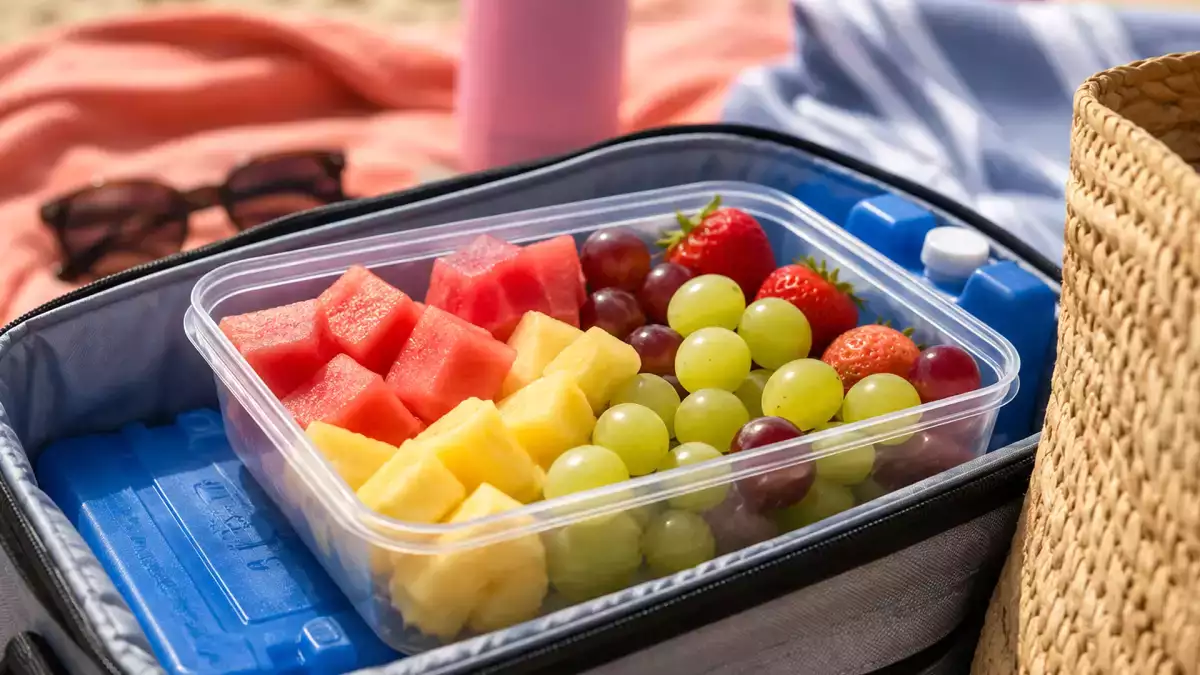
Few things are more appealing at the beach than opening a cold watermelon, eating grapes under the umbrella or taking a peach for after a swim. Fruit seems to be made for summer: it's refreshing, light, unceremoniously portioned and doesn't require much cooking. But even something so simple has its nuances when you leave the house in the heat of the day.
The question is not to stop taking fruit to the beach, but to understand that not all fruit behaves the same. Because between leaving the house with the cooler and taking a snack after the first swim, more things happen than it seems. It's not the same to carry a whole piece of fruit as a cut fruit, or a freshly washed fruit as another overripe one. It's not about eating with fear, but about not letting the heat spoil one of the simplest pleasures of summer.
Whole fruit is better than cut fruit
For the beach, whole fruit is almost always the easiest and safest option. Apples, bananas, apricots, nectarines, peaches, plums, and grapes travel better when they are whole, undamaged, and not bruised. If you are going to eat them as they are at the beach, it is best to wash them beforehand and dry them well.
Cut fruit can be a good option too, but it needs a little more care. With a whole piece of fruit, the skin acts as a first barrier. Once you remove it or cut through it with a knife, the flesh becomes more exposed: to the cutting board, to your hands, to the container, and later, to the beach environment.
If it is cut, it must stay cold
Watermelon, cantaloupe, pineapple, or mango cubes are convenient, yes, but they should be treated like fresh foods that need refrigeration. Ideally, cut them just before leaving, place them in a clean, sealed container, and put them straight into a cooler with ice packs.
Do not leave them “just for a moment” in the beach bag, next to the sunscreen, or on the towel while you set up the umbrella. In summer, losing cold happens much faster than getting it back.
Wash before cutting, even if you are going to peel it
Before cutting fruit, it is best to wash it, even if you plan to peel it. With fruits like melon or watermelon, the knife can carry dirt from the rind into the flesh. Running water is enough: rinse, rub well, and dry with a paper towel or a clean cloth.
There is no need for soap, bleach, or special products. Just use tap water, rub well, and dry properly. Small fruits, such as grapes or cherries, should also be washed and dried well before storing. If they go into a sealed container while still wet, they will spoil faster.
Melon and watermelon need a little extra care
They are summer favorites, but once cut, they deserve a little attention. They contain a lot of water, are usually eaten cold, and are often packed already cut into pieces, ready to pick up and share. All of that makes them very convenient, but also more delicate if they spend too much time out of the cooler.
A good solution is to bring larger pieces with some of the rind still attached instead of cutting the fruit into very small cubes. The less the fruit is cut, the less surface is exposed. And if you do bring it already chopped, pack a small amount and plan to eat it soon.
A cooler also has its own rules
A portable cooler helps, but only if it is used properly. It should leave home already cold, with enough ice packs, stay in the shade, and be opened as little as possible. If someone is looking for a drink every two minutes, the temperature rises and the cold disappears.
That is why, whenever possible, it is better to separate food and drinks into different coolers. It is also important that melted ice water does not come into direct contact with food. Fruit should be closed, protected, and not floating between bottles and open bags.
Time matters too
The practical rule is simple: cut fruit should not spend more than two hours out of the cooler. If it is very hot, that window drops to one hour. And at the beach, heat builds up very quickly. A bag left in the sun or the trunk of a car can be much hotter than the air around you.
If a container of cut fruit has been out of the cold for longer than that, the safest choice is to throw it away, even if it smells fine and looks normal. Microorganisms do not always announce themselves with a bad smell, a change in color, or a suspicious texture.
Be careful with the car
In summer, a closed vehicle heats up very quickly. Leaving cut fruit in the trunk while you park, look for a spot, or unload everything is not a good idea.
If the fruit is in a cooler, take it out as soon as possible and place it in the shade.
The way you eat it matters too
At the beach, there is sand, sunscreen, phones, toys, towels, and plenty of hands going in and out of containers. Bringing napkins, clean utensils or reusable picks, a trash bag, and something to clean your hands helps more than it seems.
Eating a whole apple is not the same as putting your fingers repeatedly into a container of chopped fruit. And when it comes to food safety, those little gestures matter too.
If the fruit will be eaten by young children, older adults, pregnant women, or people with weakened immune systems, it is better to be even more careful: choose whole fruit, or cut fruit that has stayed refrigerated until the moment it is eaten.
The idea to remember
The idea is simple: whole fruit whenever possible; cut fruit only if it stays cold, covered, and is eaten soon.
With that basic rule, fruit remains one of the best things to bring to the beach: fresh, easy, and perfect for summer; as long as the heat does not get to decide for you.
 Patricia González
Comments