The case for British seaside food: why its simple flavors still satisfy more than fine dining
Friday 21 August 2026 12:00 - Juliette Hess
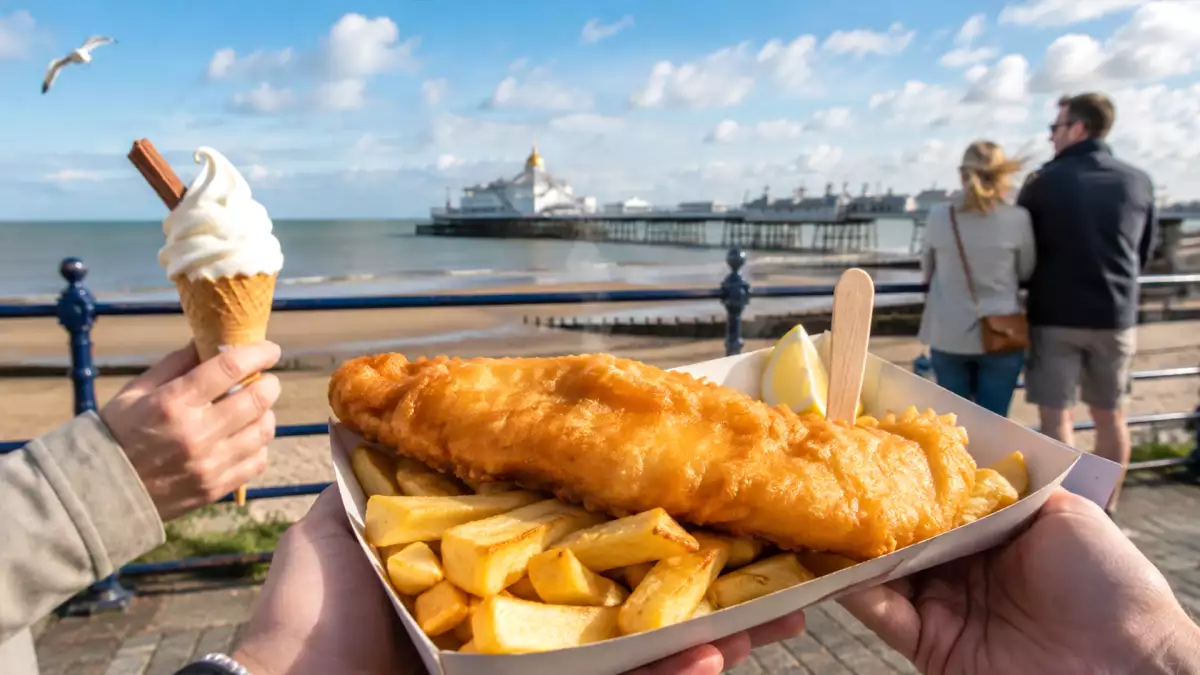
It is not just about taste, although hot chips with vinegar, a 99 Flake, fresh crab sandwiches, cockles, doughnuts and tea in a polystyrene cup all make a strong case. It is about where you eat them, who you are with, how the food arrives, and the way it connects to memory. Seaside food is rarely precious. It is salty, hot, sweet, messy, immediate and gloriously democratic. You do not need a reservation, a dress code or a vocabulary for foam.
So why does British seaside food still beat fine dining? Because it understands something essential: food is not only an object on a plate. It is weather, nostalgia, appetite, tradition, landscape and timing. And sometimes the best meal of the year is not served under a chandelier. It is eaten from paper, with wind in your hair and vinegar on your fingers.
It tastes better because of where you eat it
A plate of fish and chips eaten indoors can be delicious. The same fish and chips eaten by the sea becomes something else entirely. The salt in the air, the noise of the promenade, the paper wrapping, the balancing act on a bench and the first chip stolen before you have even sat down all become part of the flavour.
Fine dining often tries to create atmosphere. The seaside already has it. You do not need mood lighting when you have a changing sky, a strip of beach, a pier and the possibility of a seagull ambush. The setting does not decorate the meal; it completes it.
This is why seaside food can be simple and still feel unforgettable. Context is the secret ingredient.
Fine dining often tries to create atmosphere. The seaside already has it. You do not need mood lighting when you have a changing sky, a strip of beach, a pier and the possibility of a seagull ambush. The setting does not decorate the meal; it completes it.
This is why seaside food can be simple and still feel unforgettable. Context is the secret ingredient.
Fish and chips are a national dish with emotional power
Fish and chips are not just a takeaway. They are part of British food history and identity. The National Federation of Fish Friers describes fish and chips as the national dish, and food historians often connect their rise to working-class life, industrial cities and the growth of the fish trade.
But the seaside gives fish and chips their most persuasive stage. Crisp batter, hot chips, salt, vinegar and a view of the water make a meal that is both humble and heroic. Fine dining can reinterpret fish and chips, but it cannot easily improve the feeling of opening that parcel beside the sea.
The genius is in the contrast: crunchy batter, fluffy chips, sharp vinegar, soft fish and cold coastal air. It is a whole sensory system.
But the seaside gives fish and chips their most persuasive stage. Crisp batter, hot chips, salt, vinegar and a view of the water make a meal that is both humble and heroic. Fine dining can reinterpret fish and chips, but it cannot easily improve the feeling of opening that parcel beside the sea.
The genius is in the contrast: crunchy batter, fluffy chips, sharp vinegar, soft fish and cold coastal air. It is a whole sensory system.
Seaside food is democratic
One of the great pleasures of seaside food is that it belongs to everyone. Families, teenagers, pensioners, day-trippers, dog walkers, cyclists, tourists and locals all queue at the same counters. You can eat standing up, sitting on a wall, leaning against a railing or walking along the promenade with a cone melting down your hand.
Fine dining can be thrilling, but it is often exclusive by design: limited tables, high prices, long bookings and rules of behaviour. Seaside food is more generous. It says, “Are you hungry? Good. Here is something hot, salty or sweet.”
That openness matters. A great food culture is not only measured by its most expensive restaurants. It is measured by the everyday pleasures people return to again and again.
Fine dining can be thrilling, but it is often exclusive by design: limited tables, high prices, long bookings and rules of behaviour. Seaside food is more generous. It says, “Are you hungry? Good. Here is something hot, salty or sweet.”
That openness matters. A great food culture is not only measured by its most expensive restaurants. It is measured by the everyday pleasures people return to again and again.
The food is built for appetite, not performance
Seaside food rarely asks to be admired before it is eaten. Chips are not waiting for a photograph. Doughnuts do not want a tasting note. Ice cream has a deadline. A crab sandwich is best before the wind gets involved.
That immediacy is part of the joy. The food is direct and physical: hot, cold, crisp, sticky, briny, sweet, buttery, vinegary. It answers hunger without making hunger feel unsophisticated.
Fine dining can turn eating into theatre, which can be wonderful. But seaside food understands appetite in its simplest form. It feeds the person first and the critic second.
That immediacy is part of the joy. The food is direct and physical: hot, cold, crisp, sticky, briny, sweet, buttery, vinegary. It answers hunger without making hunger feel unsophisticated.
Fine dining can turn eating into theatre, which can be wonderful. But seaside food understands appetite in its simplest form. It feeds the person first and the critic second.
Nostalgia is not a weakness
People sometimes dismiss nostalgia as sentimental, but with seaside food it is part of the appeal. A 99 Flake, a paper bag of doughnuts, candy floss, chips on the pier, winkles, cockles, tea, crab sandwiches or a slice of cake from a beach café can unlock years of memory in one bite.
English seaside culture has long been tied to leisure, bathing, piers, holidays and snacks. English Heritage has described the seaside as full of nostalgia and tradition, from fish and chips on the promenade to a classic 99. That emotional layer is why the food feels bigger than itself.
Fine dining may impress you. Seaside food often remembers you. That is a very different kind of power.
English seaside culture has long been tied to leisure, bathing, piers, holidays and snacks. English Heritage has described the seaside as full of nostalgia and tradition, from fish and chips on the promenade to a classic 99. That emotional layer is why the food feels bigger than itself.
Fine dining may impress you. Seaside food often remembers you. That is a very different kind of power.
It celebrates imperfection
Part of seaside food’s charm is that it is never completely controlled. The chips may be too hot. The vinegar may be too enthusiastic. The ice cream may lean dangerously. The doughnut sugar will escape. The crab sandwich may require napkins you do not have.
In fine dining, mess is usually the enemy. At the seaside, mess is proof that the food is alive in the moment. You are not eating a composition. You are negotiating with weather, appetite and gravity.
That imperfection makes the meal more human. Some foods are better when they are not trying too hard.
In fine dining, mess is usually the enemy. At the seaside, mess is proof that the food is alive in the moment. You are not eating a composition. You are negotiating with weather, appetite and gravity.
That imperfection makes the meal more human. Some foods are better when they are not trying too hard.
Sweet seaside food has its own kind of genius
British seaside sweets are not subtle, and that is exactly the point. Ice cream, hot doughnuts, fudge, rock, candy floss, waffles, crepes and bright beach-shop treats all understand holiday logic. They are not everyday foods. They are part of being somewhere else, even if that somewhere else is only an hour from home.
English Heritage notes that ice cream had become popular and inexpensive in Britain by the mid-19th century, and it remains one of the great beach pleasures. A cone by the sea tastes different from the same cone in a shopping centre because it belongs to the day.
Fine dining desserts can be exquisite. But a melting ice cream on the promenade has urgency, comedy and joy. Sometimes joy beats precision.
English Heritage notes that ice cream had become popular and inexpensive in Britain by the mid-19th century, and it remains one of the great beach pleasures. A cone by the sea tastes different from the same cone in a shopping centre because it belongs to the day.
Fine dining desserts can be exquisite. But a melting ice cream on the promenade has urgency, comedy and joy. Sometimes joy beats precision.
The best seaside food is local without shouting about it
At its best, seaside food is connected to place. A crab sandwich in Cromer, oysters in Whitstable, kippers in Whitby, cockles in Leigh-on-Sea, pasties in Cornwall, mussels in Wales or smoked fish in Scotland all tell you where you are without needing a long menu essay.
Fine dining often talks about provenance, and that can be meaningful. But seaside food can make provenance feel immediate: the harbour is there, the boats are there, the wet air is there, and the food feels like part of the landscape.
The strongest coastal meals do not need to announce authenticity. They taste like the place that made them.
Fine dining often talks about provenance, and that can be meaningful. But seaside food can make provenance feel immediate: the harbour is there, the boats are there, the wet air is there, and the food feels like part of the landscape.
The strongest coastal meals do not need to announce authenticity. They taste like the place that made them.
It turns ordinary rituals into holidays
A sandwich is usually just a sandwich. At the seaside, it can become a moment. Tea is usually tea. At the seaside, it becomes warmth against the wind. Chips are usually chips. At the seaside, they become a reason to sit down and look at the horizon.
This is why British seaside food is so resilient. It turns small rituals into mini holidays. You do not need a luxury budget. You need a paper cup, a cone, a tray, a bench or a low wall with a view.
Fine dining is an event. Seaside food makes the everyday feel like an event. That may be the more impressive trick.
This is why British seaside food is so resilient. It turns small rituals into mini holidays. You do not need a luxury budget. You need a paper cup, a cone, a tray, a bench or a low wall with a view.
Fine dining is an event. Seaside food makes the everyday feel like an event. That may be the more impressive trick.
It is food with weather in it
Fine dining usually tries to remove discomfort: no wind, no rain, no cold fingers, no sand, no gulls. Seaside food accepts the weather and somehow becomes better because of it. Hot chips matter more when your hands are cold. Tea tastes better after a windy walk. A doughnut feels more heroic when the sky is threatening rain.
British seaside food understands the British climate. It does not wait for perfect sunshine. It works in drizzle, cloud, bright wind and sudden downpours. It is built for reality, not fantasy.
That is why it feels so emotionally accurate. It is not pretending the day is perfect; it is making the day better anyway.
British seaside food understands the British climate. It does not wait for perfect sunshine. It works in drizzle, cloud, bright wind and sudden downpours. It is built for reality, not fantasy.
That is why it feels so emotionally accurate. It is not pretending the day is perfect; it is making the day better anyway.
Fine dining can learn from the seaside
The point is not that fine dining is bad. Great restaurants can be imaginative, skilled and memorable. But British seaside food offers lessons that even the most ambitious kitchens could respect: serve something people genuinely crave, make the setting matter, do not underestimate pleasure, and remember that simplicity can be profound.
There is nothing wrong with technique. But technique without joy is cold. Seaside food may be less refined, but it understands generosity, appetite and place with remarkable clarity.
In a world where food can become over-explained, seaside classics remind us that delicious does not need to be complicated.
There is nothing wrong with technique. But technique without joy is cold. Seaside food may be less refined, but it understands generosity, appetite and place with remarkable clarity.
In a world where food can become over-explained, seaside classics remind us that delicious does not need to be complicated.
The takeaway
British seaside food still beats fine dining because it offers something restaurants often struggle to manufacture: memory, landscape, appetite, informality and joy. Fish and chips, ice cream, doughnuts, crab sandwiches, cockles, tea and beach cafés are not just foods. They are rituals of the coast.
Fine dining can impress, surprise and delight. But seaside food does something more elemental. It connects taste to weather, place and shared experience. It feeds you without asking you to behave too carefully.
That is why the best meal of the summer may not be the most expensive one. It may be chips eaten from paper, beside the sea, with vinegar on your fingers and the gulls watching like professional thieves. And honestly, that is very hard to beat.
Fine dining can impress, surprise and delight. But seaside food does something more elemental. It connects taste to weather, place and shared experience. It feeds you without asking you to behave too carefully.
That is why the best meal of the summer may not be the most expensive one. It may be chips eaten from paper, beside the sea, with vinegar on your fingers and the gulls watching like professional thieves. And honestly, that is very hard to beat.
 Juliette Hess
I have been creating culinary content for Petitchef since 2017.
I love travelling and discovering new dishes, trying out new food trends and exploring new restaurants.
I’m a huge fan of pasta and noodles in all their forms ❤ from udon noodles to tagliatelle, I love cooking them and even making them from scratch!
I’m currently preparing, filming and photographing your next recipe, and I hope you’ll enjoy it!
I love travelling and discovering new dishes, trying out new food trends and exploring new restaurants.
I’m a huge fan of pasta and noodles in all their forms ❤ from udon noodles to tagliatelle, I love cooking them and even making them from scratch!
I’m currently preparing, filming and photographing your next recipe, and I hope you’ll enjoy it!
Comments