Try this simple kitchen trick to release fresh basil’s full aroma just before you add it to dishes
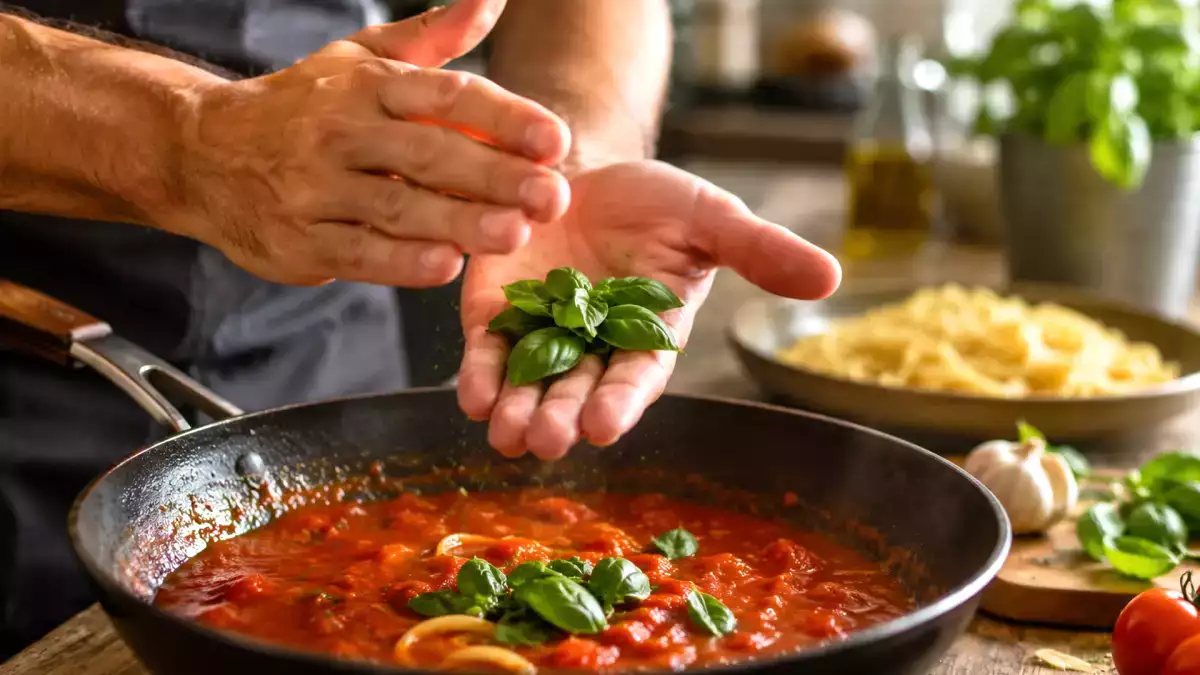
I saw chef Jordi Cruz do it in a video on his social media while making pasta with tomato and basil alongside his son. It was a tiny gesture, almost insignificant, the kind of thing that could easily look like a random movement if you were not paying attention. He picked up a few basil leaves, placed them in the palm of his hand, and right before adding them to the sauce, gave them a quick slap.
I could not tell you how long the moment lasted. Probably barely a second. But I kept thinking about it much longer than I expected. Because in cooking, some gestures look like nothing, and yet they are rarely completely accidental. Especially when they come from someone like Jordi Cruz, chef of ABaC, the Barcelona restaurant awarded three Michelin stars.
My first thought was simple: was he just playing with his son, or was he doing something I did not know how to interpret? The moment felt casual, even playful. But the gesture was too precise, too clean, to feel meaningless. And the more I thought about it, the clearer it became that these small details are worth noticing.
Herb slap: the technique that wakes up aroma
So I looked into it. The answer was more interesting than it first seemed: it was not a random gesture or an empty flourish.
Gently slapping a fresh herb like basil lightly bruises it and helps release some of its essential oils. In other words: it makes it smell more fragrant.
It is also a well-known trick in cocktail making, where bartenders use it with mint or basil before adding the herb to a drink, precisely to intensify the aroma without destroying the leaf. The gesture is often called an “herb slap.”
Just one quick slap
The idea is not to crush the basil, squeeze it, or rub it between your fingers until it wilts.
The goal is simply to wake it up.
One brief slap is enough to break some of the most superficial structures of the leaf and help the aroma come through more clearly. It is a tiny gesture, yes, but it makes sense.
And in a tomato sauce, where basil is usually added at the end to preserve its fresh, green fragrance, that detail matters even more. Cook it too long and the aroma fades. Add it at the very end, lightly slapped, and it perfumes the dish with much more brightness.
What is interesting is not only the technique, but what it reveals
Cooking well is not always about doing big things. It is not always about complicated techniques, dramatic gestures, or turning every dish into a performance.
Sometimes, it is this: understanding how a simple basil leaf behaves. Knowing when it should go into the pan. Knowing how much to touch it so it gives you its best without ruining its delicacy.
A detail that stays with you
That is why the gesture sticks in your mind.
Because it looks silly, but it is not. From the outside, it could be mistaken for a habit, a chef’s little quirk, or even a playful move meant to entertain a child for a second.
But behind it, there is knowledge. Or at least the memory of a craft.
A cook’s intuition does not come from nowhere. Most of the time, it is made of small lessons accumulated over years.
There is also something beautiful about that. The idea that high-level cooking, or simply attentive cooking, can still depend on gestures as humble as giving a basil leaf a quick slap.
Maybe that is why the scene works so well as an image. Not because it reveals an extraordinary secret, but because it reminds us of something more useful: cooking is full of details that seem minor until you understand them.
And sometimes, the difference between adding basil to a sauce and making that sauce truly smell like basil fits into a gesture so small it almost feels embarrassing to call it a technique.
But it is one.
What exactly does slapping basil do?
Gently hitting the leaf helps release aroma without fully breaking it down.
That allows you to:
- intensify its fragrance right before serving
- avoid bruising or oxidizing it too much
- keep its visual presence on the plate
- make the most of a delicate herb without exposing it to long cooking
It will not turn a simple pasta into a completely different dish, but it can help it smell and taste better.
How to do it at home
Place a few clean, dry basil leaves in the palm of one hand and give them a small slap with the other, right before adding them to a finished sauce or directly to the plate.
After that, you can add them whole, tear them by hand, or roughly chop them, depending on the result you want.
The only precaution is not to overdo it. If you squeeze or crush the leaves too much, they lose their charm, become too wet, and can develop harsher notes.
The point is not to punish the herb. It is to wake it up.
A small detail that explains everything
Maybe that is what I saw that day: not a performance, not a pose, and not even a technique in the most serious sense of the word, but a cook’s gesture.
One of those gestures that almost looks ridiculous because it is so discreet, yet contains a very serious way of looking at ingredients.
So the next time you see someone slap a few basil leaves before adding them to a dish or a drink, now you know they are not necessarily playing around.
Though, of course, they might be doing that too.
 Patricia González
Comments