Why do the French drink cocktails before a meal, while in Spain people usually have them after?
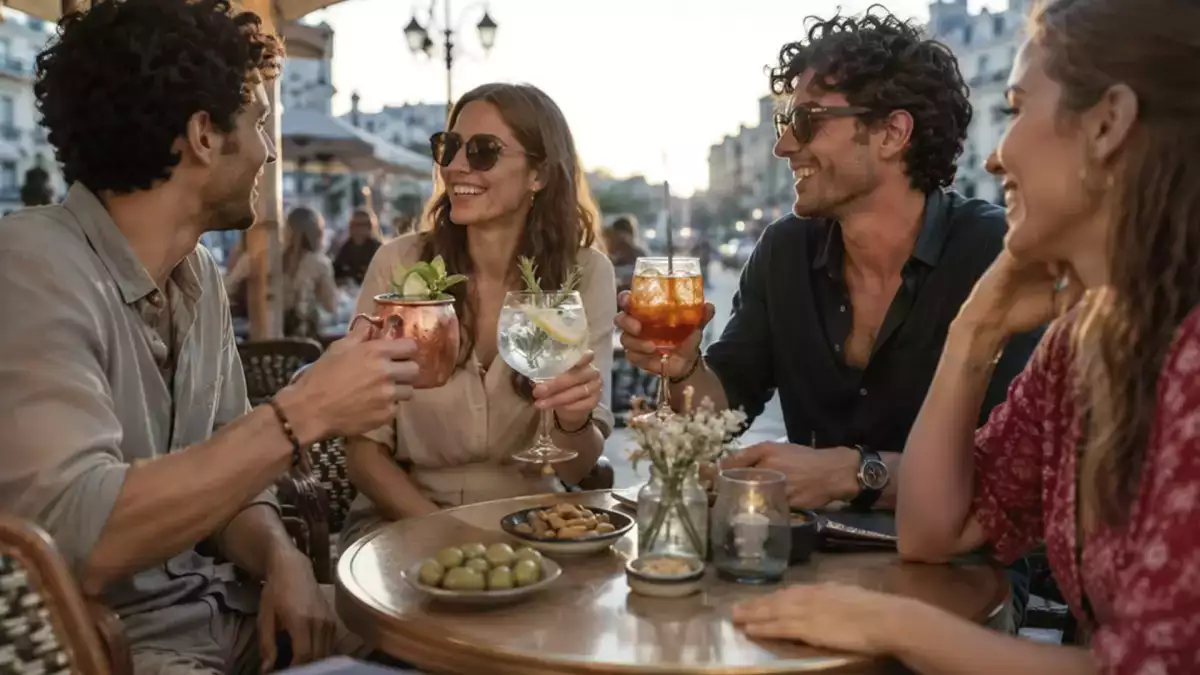
I did what my French colleagues did, although I found it odd. The first time I ordered a Moscow Mule before dinner in France, I thought maybe I was bringing the night forward too much. It was just after seven o'clock, it was still light outside and at the next table someone had ordered a Spritz, another a gin and tonic and a third a Moscow Mule. We hadn't even started dinner. But no one seemed to look weird. No one seemed to be "having a drink" as we would understand it in Spain. No, they weren't fast-forwarding the after-dinner conversation. And that's how I learned that they were making the apéro.
In France, a cocktail with vodka, gin or bitter can be part of the aperitif: it is taken before lunch or dinner, accompanied by something salty and a conversation that has not yet entered the territory of the table. In Spain, on the other hand, the same gin and tonic usually sounds more like an after-dinner drink, at the end of a meal with friends or family, a nightcap or an after-coffee drink. The drink may be the same; the moment, completely different.
Similar customs at different times
Some customs are better understood at the table than in books. In France, ordering a cocktail before a meal can be a perfectly natural gesture: a gin and tonic, a Moscow Mule, a Spritz or a short cocktail serves to whet the appetite, accompany a few small bites and mark the beginning of the meal. In Spain, on the other hand, that same drink tends to sound more like an after-dinner drink, a nightcap or the beginning of the more relaxed part of lunch or dinner.
It is not that one country drinks "better" than another. It is that alcohol occupies different places within the gastronomic ritual.
The French apéro: drinking before sitting at the table
In France, the apéritif, or simply apéro, is much more than a drink before a meal. It is a social moment. It is taken before lunch or dinner, often with something salty to nibble on, and serves to whet the conversation as well as the appetite.
The word apéritif itself comes from the idea of "to open". It has traditionally been associated with dry, bitter or aromatic drinks: vermouth, pastis, kir, champagne, fortified wines or light cocktails. Over time, that space has expanded and today it can also include gin, vodka, bitters, citrus or bubbles.
The key is in the moment. The cocktail does not necessarily appear at the end of the meal, but as a prologue. It does not close the experience: it inaugurates it.
In Spain, the aperitif exists, but it does not always mean the same thing.
Spain also has a very strong aperitif culture. Just think of the vermouth, the caña before lunch, the fino, the manzanilla, some olives, some potato chips, some gildas or a tapa at noon. The Spanish aperitif is not lesser or poorer: it is something else.
The difference is that, for many Spaniards, spirits and mixed drinks with higher alcohol content do not belong so much to that moment before the meal. A gin and tonic, a whiskey on the rocks, a rum and coke or a cocktail with vodka are usually associated more with the afternoon, the evening, the long after-dinner conversation or the after-dinner drink.
That is why, in France, having a cocktail before dinner is perceived as something normal and even elegant. In Spain, on the other hand, it is usually read more as a festive or nocturnal gesture, unusual before eating.
The desktop changes the order of things
To understand this difference, we must look at one of the great Spanish institutions: the after-dinner meal. In Spain, the meal does not always end when the dishes are cleared away. Then comes the coffee, the chat, perhaps a liqueur, a brandy, a pacharán, an orujo or a long drink (a gin and tonic, a whiskey on the rocks, a rum and coke) to continue the conversation without getting up yet.
This final section has a function similar to that of the French apéro , but placed on the other side of the meal. If the apéro sets the mood before the meal, the after-dinner conversation prolongs it afterwards.
This is one of the cultural keys: in France, the drink can serve to open the evening; in Spain, it often serves to lengthen it.
What is being done in the rest of Europe?
Europe does not have a single custom. Italy, for example, shares with France a very strong aperitif culture, with drinks such as Spritz, Negroni, Campari or vermouth before dinner. In other countries, fortified wines, herbal liqueurs or eaux-de-vie are more associated with the end of the meal.
It is also advisable not to exaggerate the borders. In France, there are digestives after a meal, just as in Spain there is the aperitif before a meal. And in both countries, habits vary greatly according to age, region, type of meal and context: a family meal is not the same as a restaurant dinner, a summer terrace as a formal celebration.
But there is a recognizable trend: France and Italy have normalized the cocktail before the meal, while in Spain strong drinks have traditionally had more weight after the meal, during after-dinner or nightlife.
Is it healthier to take it before or after?
From a health point of view, the answer should not be approached as a competition. A cocktail with distilled spirits is still an alcoholic beverage, whether it is drunk before or after a meal. And the higher the strength, quantity and frequency, the less innocent it is.
That said, timing can influence how it is tolerated. Drinking hard alcohol on an empty stomach can promote faster absorption and a more abrupt feeling of drunkenness. Drinking it with food, or after a meal, can soften that effect, although that does not make it a healthy habit.
The most important difference is not only in the clock, but in the quantity, the rhythm, the accompaniment and the context. A short cocktail with ice and some snacks is not the same as several drinks in a row before dinner. Nor is a small liqueur after a meal the same as an after-dinner drink without measure, in which the glass stops accompanying the conversation and starts to take up too much space.
Two ways of understanding the table
Gastronomic customs, like almost everything that happens around a table, depend on where you grew up, what time you eat dinner at home and what seems "normal" to you without really knowing why. For a Frenchman, having a cocktail before dinner may be a natural way to open the evening. For a Spaniard, that same gin and tonic usually belongs more to the after-dinner, evening or long drink after coffee.
But therein lies the charm of watching how others eat and drink: in discovering that the order of things also tells a story. France puts the pleasure in the anteroom, with the apéro; Spain stretches it to the end, with the sobremesa. The timetable changes but not the important thing; because in the end, it is not whether the drink arrives earlier or later, but whether it serves the same purpose: to sit down, share and enjoy.
And you, when do you drink cocktails? Before or after dinner? Tell us in the comment section :-)
 Patricia González
Comments