Hyper-real fruit in pastry: the bakery trend tricking our eyes and redefining dessert presentation
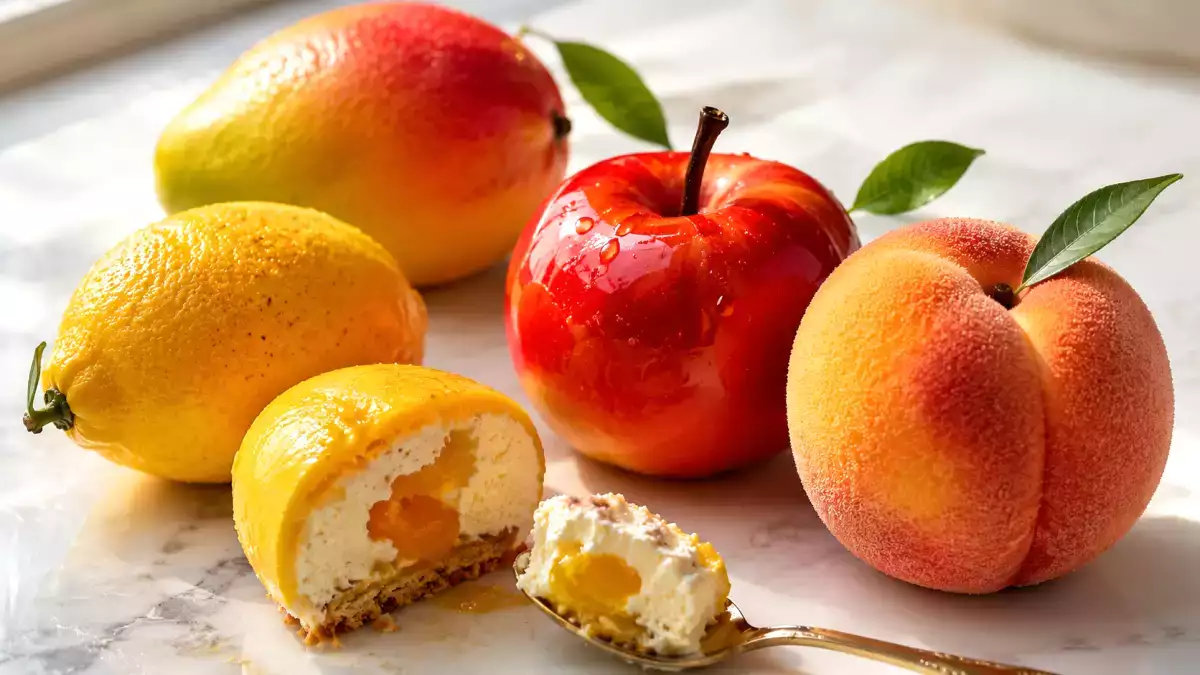
A velvety peach, a lemon with an uneven peel, or an apple so shiny it looks as if it were freshly picked. Then comes the teaspoon; the shell cracks open, and instead of fruit flesh, colorful mousses, creams, and fillings appear.
This is the secret behind realistic fruit: the pastry trend that transforms ordinary fruits into spectacular desserts. The eyes expect one thing, while the palate discovers another.
What is realistic fruit?
Realistic fruit is a single-serving pastry shaped like a piece of fruit, designed to replicate its color, shape, and even the small imperfections on its skin.
These desserts are also called trompe-l’œil desserts, an expression that means “tricks the eye.” From the outside, they may look like an apple, a lemon, a pear, a strawberry, or a mango. Inside, however, they hide mousses, creams, fruit jellies, and crispy bases.
The result is a dessert that looks as if it just came from the fruit stand, at least until you take the first bite.
Cédric Grolet and the success of fruit-shaped desserts
Among the pastry chefs who have helped make realistic fruit famous is Cédric Grolet, a French pastry chef known for his refined trompe-l’œil desserts.
His creations replicate apples, lemons, peaches, mangoes, and other fruits with such precise details that they look real. Beneath the surface, however, they conceal light mousses, creams, fruit fillings, and crunchy textures.
His work has transformed fruit-shaped desserts into a symbol of contemporary pastry art, demonstrating that the element of surprise can coexist with technique and flavor.
How do you make realistic-looking fruit?
Making a realistic dessert requires precision. It’s not enough to simply pour mousse into a mold: every element must contribute to making the fruit look believable.
Typically, a single-serving dessert contains:
- a soft fruit center;
- a creamy mousse;
- a sponge cake, shortcrust pastry, or praline base;
- a thin chocolate shell;
- a decoration that resembles the fruit’s skin;
- small details such as leaves and stems.
The dessert is often made using silicone molds and chilled before being decorated. The most delicate step is the finishing touch: a color that’s too uniform risks making the dessert look like plastic.
To make it look realistic, shading, dots, and slight irregularities are added. In this case, a few imperfections are almost a virtue.
Why do people like realistic fruit so much?
The first reason is obvious: it’s a pleasure to look at. When it arrives at the table, it piques your curiosity, surprises you, and makes you want to find out what’s inside.
The most fun part, however, comes when you cut into it. The crispy shell cracks open to reveal a completely different interior, filled with creams, mousses, and fruit fillings.
Realistic pastries work because they combine three elements:
- a surprising appearance;
- the play on illusion;
- the curiosity to discover the filling.
It’s not just a dessert to photograph. When the recipe is well-balanced, the visual effect is just the beginning of the experience.
What does realistic fruit taste like?
There is no single flavor. Every fruit can hide a different combination.
A mango might contain tropical mousse and a passion fruit center. A lemon might combine citrus cream, vanilla, and almond. An apple might contain cinnamon, caramel, or a slightly tart compote.
Among the most popular flavors are:
- lemon and orange;
- mango and passion fruit;
- strawberry and raspberry;
- apple, pear, and peach;
- pistachio and hazelnut;
- chocolate, coconut, and vanilla.
The exterior doesn’t always reveal all the ingredients inside. Pastry chefs often add spices, chocolate, or nuts to create more interesting contrasts.
Is realistic fruit good, or is it just pretty?
A dessert can look perfect in a photo but be underwhelming when tasted. That’s why the realism of the fruit depends above all on the balance of textures.
The shell should be thin, the mousse creamy, and the filling fresh. If the coating is too thick, the chocolate risks overpowering the other flavors. If the mousse is too sweet, the taste of the fruit takes a back seat.
Temperature also matters. If served too cold, the single-serving dessert can be hard and lack aroma. At the right temperature, however, it becomes creamier and more aromatic.
The appearance catches the eye, but it’s the flavor that determines whether it’s truly worth remembering.
Can you make realistic-looking fruit at home?
Yes, although it takes a little patience. To start, it’s best to choose a simple shape, like a lemon or an apple, and use just a few ingredients.
A homemade version can be made with fruit mousse, a jam center, and a coating of colored white chocolate. Silicone molds help you achieve a precise shape.
The hardest part is still the decoration. My advice is not to aim for a perfectly uniform surface: a few variations in color and a small imperfection make the result look more natural.
Even a slightly lopsided apple can look great, especially if it hides a delicious filling inside.
A dessert that plays with expectations
Realistic fruit makes a very simple gesture special: dipping a spoon into a dessert.
At first, it looks like real fruit; a moment later, it becomes a combination of mousse, creams, and crunchy layers. When aesthetics don’t overshadow the taste, the result is fun, original, and definitely hard to ignore.
After tasting a peach stuffed with mousse, however, even an ordinary fruit basket might start to seem suspicious.
Where can you find realistic fruit desserts in the U.S.?
Realistic fruit desserts are still more common in high-end pastry shops, luxury hotels, and chef-driven bakeries than in everyday neighborhood bakeries. But the trend is becoming more visible in the U.S., especially in cities with strong pastry scenes such as New York, Los Angeles, Chicago, Miami, and Las Vegas.
You may see them in French-style pâtisseries, modern dessert bars, upscale restaurants, or special-order pastry boutiques. They often appear as limited-edition creations because they take time, skill, and careful finishing.
If you want to try one, it is worth checking a bakery’s current menu or social media before going. These desserts can change by season, and some are made only in small quantities.
Because with realistic fruit desserts, half the pleasure is the surprise and the other half is getting there before they sell out.
 Leandra Masha
Comments