Does your persimmon leave your tongue feeling all rough? Here's why!
Saturday 14 November 2026 21:00 - Adèle Peyches
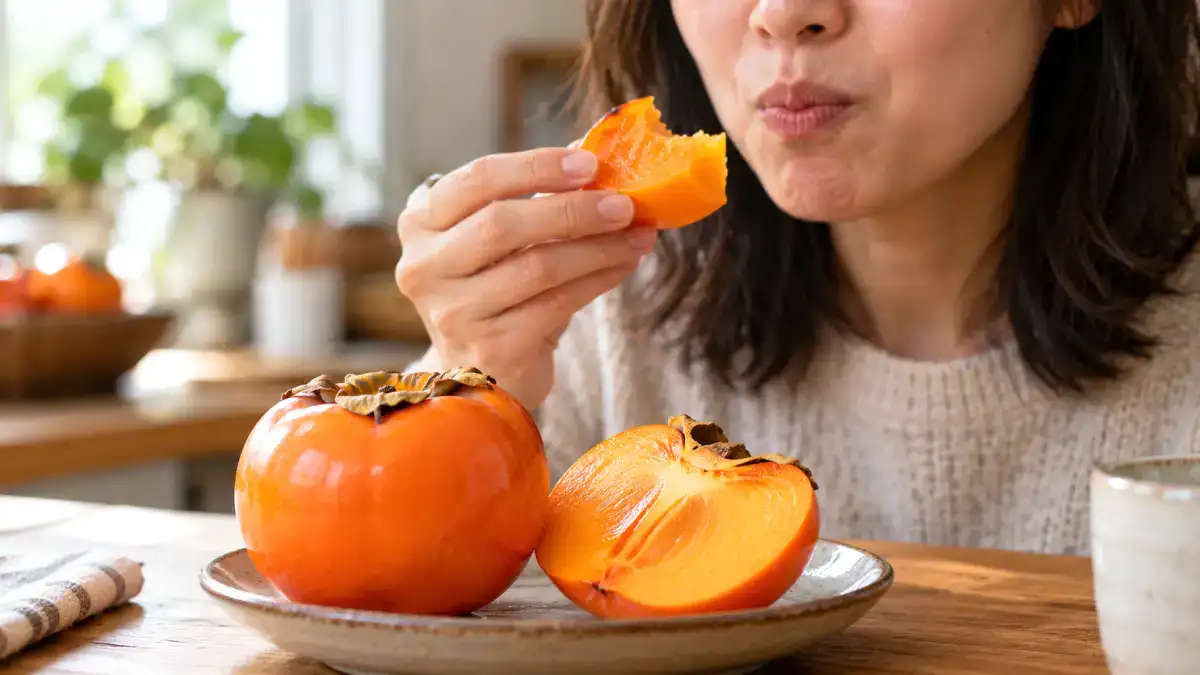
The problem? Sometimes, at the very first bite, our tongue feels all scratchy! It’s a surprising sensation—and sometimes downright unpleasant… But why does this seemingly appetizing fruit play such a nasty trick on us?
At Ptitchef, we’ve looked into the matter. And rest assured: there are some very simple tips to help you pick the right persimmon every time ;-)
This sensation has a name: astringency
Have you ever drunk a very strong cup of tea or tasted a wine that makes your mouth feel dry? It’s kind of the same phenomenon!
Some persimmons contain soluble tannins. When they come into contact with saliva, these substances make your mouth feel dry and cause your tongue to stick to the roof of your mouth.
So it’s not that the fruit actually “scratches” your tongue. It’s a sensation called astringency.
But then, why can your neighbor bite into a firm persimmon without any trouble, while yours seems impossible to eat? The answer lies in the varieties.
Not all persimmons are eaten the same way
There are astringent persimmons and non-astringent persimmons.
The former, such as certain Hachiya-type varieties, generally need to become very soft before they can be eaten. Their flesh then takes on an almost gelatinous texture, perfect for eating with a spoon.
The latter, such as the Fuyu, can be eaten while still firm, much like an apple. This makes them easy to cut into wedges!
Our tip for the market? Just ask the vendor whether the persimmon is meant to be bitten into or eaten with a spoon. A quick question that saves you from a big grimace ;-)
Watch out for the color!
You might think that a bright orange persimmon is automatically ready to eat. Well, no!
The color of the skin isn’t enough to tell if an astringent persimmon is ripe. It can look beautiful and still leave that famous dry sensation in your mouth.
For an astringent variety, rely mainly on its texture: wait until it becomes very tender. For a non-astringent variety, flesh that’s still firm is generally fine as long as the fruit is ripe.
In any case, make sure the fruit is healthy. A persimmon that’s very soft because it’s ripe is not the same as one that’s moldy or damaged.
How do you ripen a persimmon at home?
Did you buy some astringent persimmons that are still firm? Let them ripen at room temperature, away from direct sunlight, and check on them every day.
You can place them near apples, which release ethylene and can speed up the ripening process. But be careful—the time required varies depending on the fruit, so don’t plan on eating them at a specific time!
When they become very soft, gently cut them open and enjoy the flesh with a spoon.
Some persimmons sold as “ready-to-eat” have also undergone professional treatment to remove their astringency. This explains why they remain pleasant to eat even when they have a firm texture.
Have you ever tasted a persimmon that was too astringent?
Not very pleasant, is it? The dry mouth sensation usually subsides over time. You can rinse your mouth and drink a little water.
But there’s no need to force yourself to finish the fruit if every bite feels unpleasant. Instead, wait until the other persimmons are ripe enough.
If you experience any unusual symptoms, such as difficulty swallowing or a severe reaction, seek medical advice: it may not just be a simple case of astringency.
Our suggestions for enjoying it
A soft persimmon is delicious on its own, eaten with a small spoon. You can also add it to cottage cheese, oatmeal, or a dessert with mild spices.
For the firm varieties, try a few wedges in a lamb’s lettuce salad with walnuts. Its sweetness pairs very well with a slightly tangy vinaigrette.
See, persimmons aren’t complicated at all! You just need to know which type you have on your hands.
And you—do you prefer them soft and melt-in-your-mouth or crisp and cut into wedges? Tell us everything ;-)
 Adèle Peyches
Editorial manager who just can't wait for winter to enjoy raclette! Passionate about gastronomy and always on the lookout for new culinary gems, I first studied law before returning to my first love: the taste of good products and the joy of sharing around the table :)
Comments