Are seed oils actually inflammatory? What human studies really show
Saturday 21 November 2026 10:00 - Juliette Hess
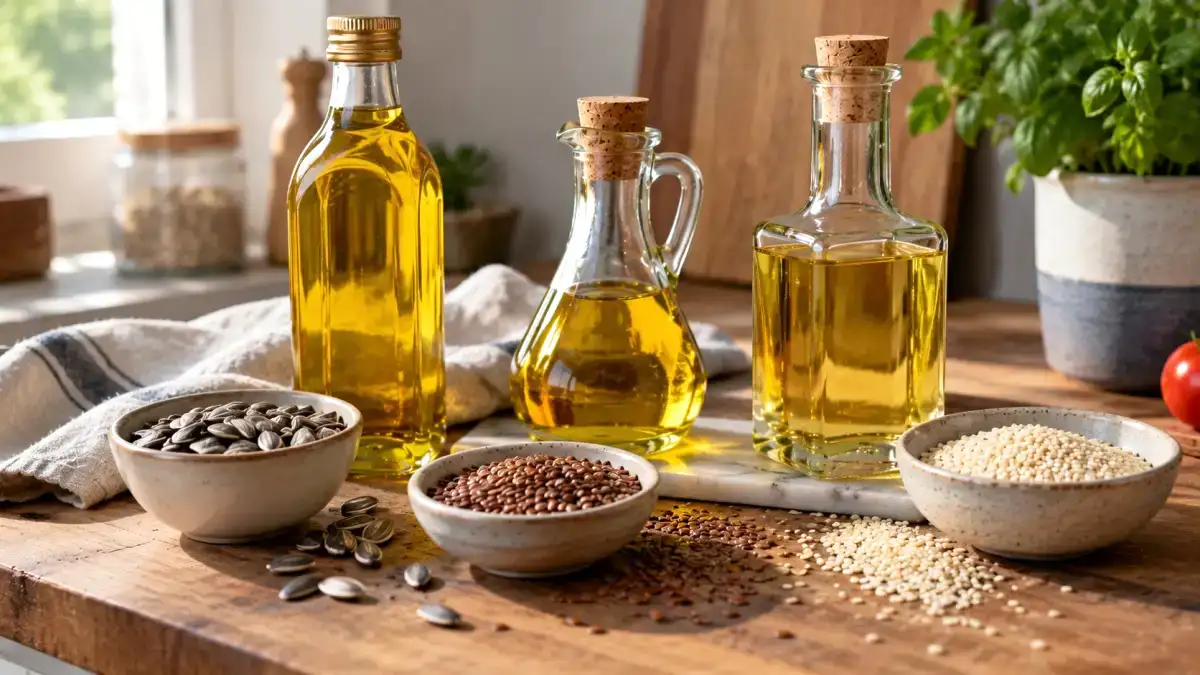
Sunflower, soybean, corn, safflower and rapeseed (canola) oils have become unlikely kitchen villains. But what happens in human studies is more useful than a dramatic social-media claim. Let's look at the evidence, what it does not prove, and what that means for dinner.
First, why do people think seed oils cause inflammation?
The argument usually starts with omega-6 fatty acids, particularly linoleic acid, found in many seed oils. Your body needs linoleic acid and cannot make it itself. It can convert a small amount into arachidonic acid, which helps produce signalling molecules involved in inflammation.
That sounds worrying when reduced to one sentence. But inflammation is also a normal part of healing, and these signalling pathways can help regulate or resolve responses as well as activate them. More importantly, a biochemical pathway does not tell us what actually happens when people eat an ingredient.
To test the claim, researchers measure markers such as C-reactive protein (CRP) and interleukin-6 (IL-6) after changing people's diets.
What do controlled human trials actually find?
Here is the key result: raising linoleic acid intake generally has not raised measured inflammation markers in randomised trials. A 2012 systematic review examined 15 trials and found virtually no evidence of increased inflammatory markers in healthy participants.
A larger 2017 meta-analysis pooled 30 randomised studies involving 1,377 people. Overall, higher linoleic acid intake did not significantly change CRP or several other inflammatory markers. The authors did flag a possible CRP increase in some analyses involving particularly large intake changes. So “no evidence of any possible effect, ever” would be going too far.
More recent direct comparisons tell a similar story. A trial published in 2024 found no significant difference in inflammation markers between diets rich in cottonseed oil and olive oil among adults with high cholesterol. In a 2025 study involving 39 adults with abdominal obesity, researchers compared safflower-oil omega-6 with fish-oil omega-3 supplementation. These are relatively small, short studies, not a lifetime guarantee, but they help test the popular claim in actual people.
What about the newest research?
A trial reported in 2026 compared foods supplying soybean oil with foods supplying palm oil in adults with overweight or obesity. Participants consumed study foods providing 30 grams of oil daily during four-week periods. Most measured inflammation markers did not change significantly with either oil.
That does not mean every seed oil behaves identically, that unlimited quantities are sensible, or that a blood test captures every aspect of health. It does mean the blanket claim that ordinary seed oils automatically trigger chronic inflammation is not supported by these human findings.
That does not mean every seed oil behaves identically, that unlimited quantities are sensible, or that a blood test captures every aspect of health. It does mean the blanket claim that ordinary seed oils automatically trigger chronic inflammation is not supported by these human findings.
Does that mean fried food is suddenly a health food?
Not quite! A bottle of oil used to dress vegetables is not the same thing as regularly eating deep-fried snacks. Foods can contain seed oils alongside plenty of salt, refined starch and added sugar. If a meal is nutritionally poor, blaming its oil alone misses the bigger picture.
There is also a difference between fresh oil used appropriately and oil repeatedly heated to very high temperatures. Repeated heating can degrade oils and produce undesirable compounds. Avoid letting oil smoke, follow its cooking recommendations and discard oil that has become dark, sticky or smells unpleasant.
And remember that oil is energy-dense, whether it comes from sunflowers or olives. A little can make vegetables delicious; pouring freely is not required for good health.
Which oil should you use in your own kitchen?
For everyday cooking, olive, rapeseed/canola, sunflower and soybean oils can all fit into a balanced diet. Choose one suited to the temperature and flavour you want. Olive oil works beautifully in dressings; rapeseed oil has a mild flavour for many dishes; a little sesame oil can transform stir-fried vegetables.
Replacing some butter or other saturated fats with unsaturated vegetable oils is consistent with heart-health recommendations. That is a different question from inflammation, but it matters when deciding what to keep in your cupboard.
Rather than obsessing over an omega-6-to-omega-3 ratio, make room for omega-3 sources too: oily fish if you eat it, plus walnuts, chia or flaxseed. Think about the whole eating pattern: vegetables, pulses, wholegrains, nuts and enjoyable meals.
The takeaway: do you need to throw away your seed oil?
No, not on the grounds that it inevitably causes inflammation. The best available human intervention studies do not show a consistent rise in common inflammatory markers from higher linoleic acid intake. The research has limitations, especially for very high intakes and long-term outcomes, so absolute claims in either direction deserve caution.
Keep the practical priorities simple: use oils sensibly, avoid repeatedly overheating them and look at the quality of your overall meals. Your salad dressing does not need to become a science controversy every lunchtime ;-)
Keep the practical priorities simple: use oils sensibly, avoid repeatedly overheating them and look at the quality of your overall meals. Your salad dressing does not need to become a science controversy every lunchtime ;-)

Growing up in her family’s restaurant inspired Juliette’s love of cooking. Since 2017, she has developed, photographed and filmed recipes for Petitchef. Trained in visual imagery and lighting, she loves exploring world cuisines, particularly Asian food.
Comments