Is 'Russian salad' actually Russian? A look at the culinary history behind this familiar cold salad
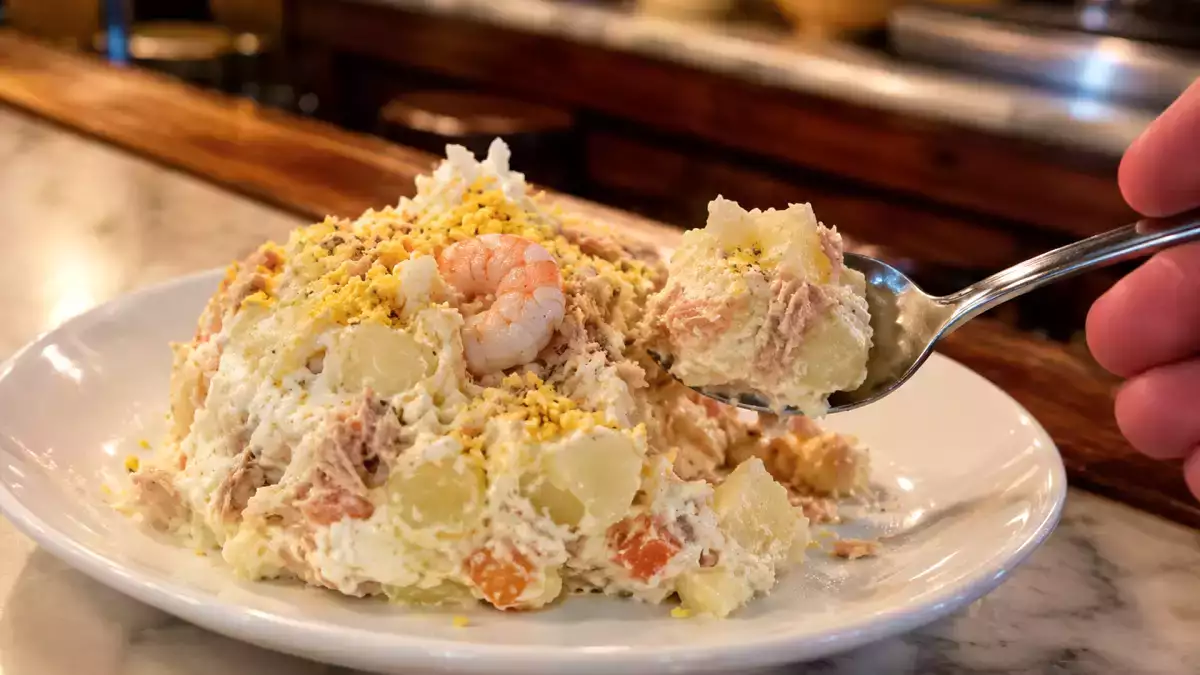
French omelets, Belén cakes, Russian salad… There are dishes that arrive at the table with a passport stuck to their foreheads. We accept them without asking too many questions, perhaps because life is already demanding enough without having to ask a tapa for its papers. But just take a closer look at that cold dish of potatoes, mayonnaise, eggs, and tuna, and its “Russian” label starts to waver. Is something so closely associated with our cuisine really Russian?
Russian salad is Russian, yes. But also no. Or rather: it’s Russian in a way that’s far more complicated than its name suggests...
The origins of Russian salad don't exactly begin where we think they do
The most famous clue takes us to 19th-century Moscow, to the Hermitage restaurant, an elegant establishment where Russian high society went to dine as much to be seen as to eat. Lucien Olivier, a chef of European origin, worked there; he is credited with creating the most famous version of this family of cold salads: the Olivier salad.
However, as Pablo de Llano Neira points out in “The Guardians of the Russian Salad, ” an article published in El País, the dish’s history doesn’t exactly begin with Olivier. Before getting to Russia and Olivier, it’s worth taking a detour. In fact, it is more accurate to say that Olivier is credited with the modern Russian salad, rather than that he simply “invented” it, because the term “Russian salad” was already in use in some 19th-century European cookbooks, such as *The Modern Cook*, published in 1845.
And in Spain, Russian salad also made an early appearance: La cocina moderna, by Manuel Garciarena and Mariano Muñoz, mentions it as early as 1857. In other words, when Olivier began to make his version famous in Moscow, the idea of a “Russian” cold salad did not come out of nowhere.
What Olivier did achieve, however, was something else: he transformed a dish of that type into a prestigious dish, associated with the luxury of imperial Russia.
The original recipe wasn't our bar-style potato salad
That, in any case, wasn't exactly the bar-style potato salad we know in Spain. There wasn't a mountain of boiled potatoes with mayonnaise, tuna, and a toothpick stuck in the top. Later reconstructions describe a much more luxurious recipe, featuring prime cuts of meat or game, seafood, pickles, capers, and a special sauce that’s part of the dish’s legend. We don’t have a definitive original recipe preserved like a notarized document, but we do have a fairly clear idea: it was a far cry from our homemade ensaladilla.
More than just a salad, it was a distillation of Muscovite luxury served cold. The curious thing is that, according to many accounts, diners ended up mixing together on their plates what the chef had arranged for decorative purposes. Olivier, seeing the enthusiasm for the chaos, would have eventually accepted defeat: if people wanted to mix everything up, he’d just serve it already mixed. The story is too good not to tell, though it’s best to take it as part of the dish’s tradition, not as an official culinary record.
From an elegant dish to a popular meal
But the story takes a turn. Before, during, and after Olivier, cold salads with mayonnaise spread throughout Europe under different names, with different ingredients, and with different aspirations. Olivier’s was the version that became famous in Moscow, but it wasn’t the only one of its kind. Then came social changes, home cooking, and the limitations of the pantry; factors that are often more decisive than any recipe set in stone.
Over time (and particularly evident in Russian and Soviet cuisine) the salad became simpler. Expensive ingredients gave way to more affordable ones: potatoes, carrots, peas, eggs, pickles, cooked meat or sausage, and mayonnaise. The Olivier salad eventually became a festive dish, closely associated with family celebrations and, in many homes, with New Year’s: hearty, cold, prepared in advance, and capable of feeding a large table without breaking the bank.
That is one of the great mysteries of the Olivier salad: it was born (at least in its most famous version) with aristocratic aspirations and ended up becoming deeply popular. As so often happens in cooking, a dish can have two lives: the formal one, born in elegant dining rooms, and the everyday one, adapted to whatever is in the pantry. Thus, Russian salad (once a dish served in expensive restaurants) became a home-cooked meal, a dish for celebrations, for a full fridge, and for generous helpings. Along the way, it lost its pomp, but gained something perhaps even more powerful: a sense of belonging.
Spain turned it into a tapa
In Spain, **Russian salad** found the perfect home. Potatoes, mayonnaise, eggs, tuna or skipjack, carrots, peas, olives, bell peppers, and shrimp in the more seafood-oriented versions: everything fit naturally between home cooking and the bar counter. The Spanish ensaladilla doesn’t try to be a faithful replica of the Olivier salad from the Hermitage. It stopped asking for permission a long time ago.
Another question is when it made the leap from cookbooks to becoming that familiar, inexpensive, and ubiquitous tapa that we recognize today at the very first spoonful. That leap seems to have come quite some time after its first written mentions, already in a simpler version, far removed from any aristocratic display.
That’s why talking about “the authentic Russian salad” is like stepping into a garden full of mayonnaise. In Russia, many versions include potatoes, carrots, peas, pickles, eggs, and meat or sausage. In Spain, tuna or bonito have become almost inevitable, although versions with shrimp, ventresca, smoked eel, fine pickles, or customized mayonnaises are increasingly common. Each country has adapted it to its own pantry. Each family, to its own way of cutting the potatoes.
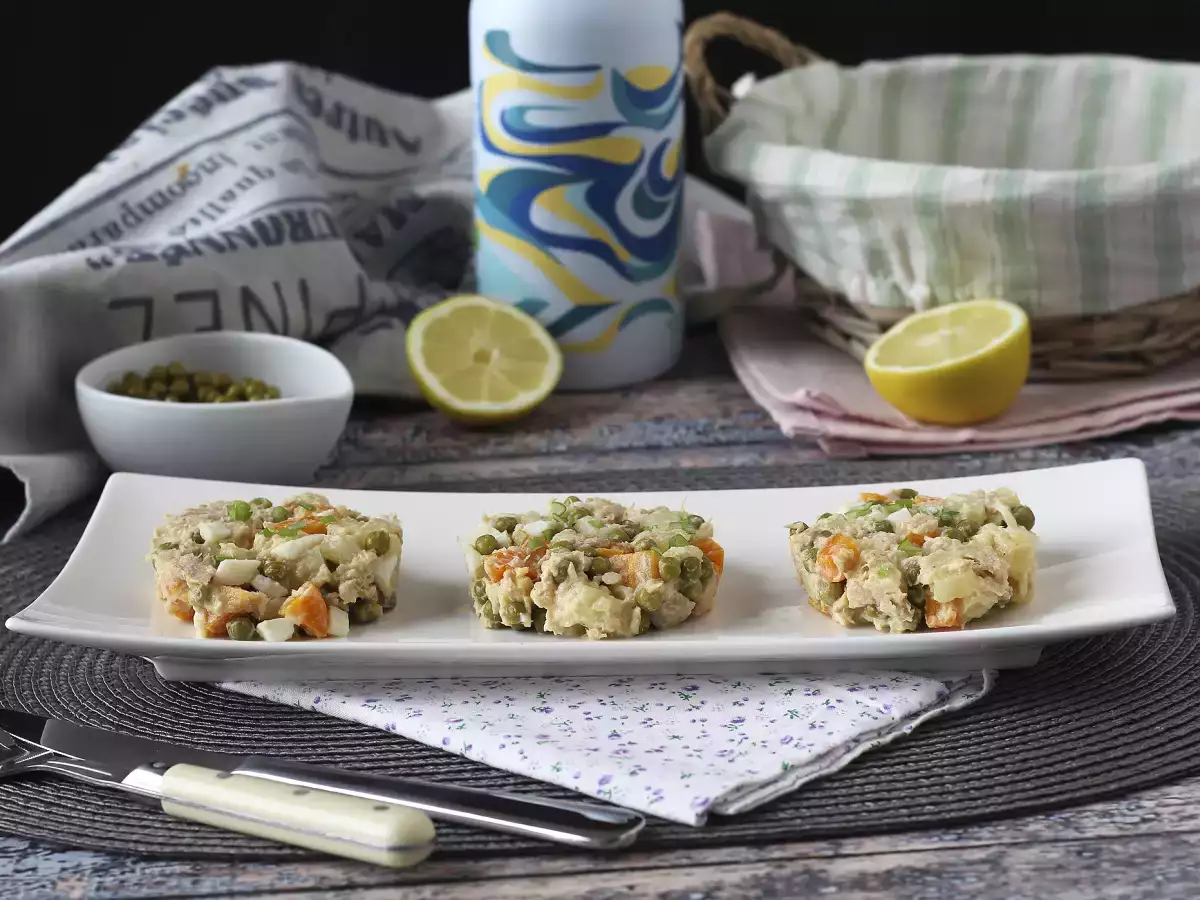
You have to try this Russian salad (which is only Russian in name, it must be said). This salad, a symbol of freshness and versatility, can be served as starter, appetizer or even as main dish. It also allows countless variations according to the...
So, is she Russian or not?
So, is Russian salad actually Russian? If we’re talking about its origins, yes: its best-known lineage traces back to Imperial Russia and later became firmly established in Russian and Soviet culture. But if we’re talking about historical accuracy, we have to admit that the name and the concept of a “Russian salad” were already in circulation before that and outside of Russia. Olivier didn’t invent a universal tapa out of thin air; he made famous a luxurious, Muscovite, and dazzling version of a family of cold salads that had already been making its way across Europe.
If we’re talking about the dish we eat in Spain—with its creamy potatoes, just the right amount of tuna, and its perfect fit for a terrace—the answer is more charming: it’s an adopted recipe. Russian in name, a traveler by history, and Spanish by choice.
Perhaps that’s why we love it so much. Because it isn’t a “pure” dish; nor does it need to be. It’s a recipe that has survived precisely because it has embraced change: from European cold salads to the Hermitage restaurant, from the Russian and Soviet table to the Spanish bar, from cold luxury to a humble spoonful. Russian salad isn’t an impostor, but neither is it a direct copy of the original Olivier salad. It’s less a dish with a passport than a recipe with a biography: it was born amid foreign names, dressed up in luxury in Moscow, simplified in homes, and ultimately found one of its happiest forms in Spain. And that, in a dish served with breadsticks and beer, is almost always a virtue.
 Patricia González
Comments