Planning school lunches in England? Here’s what the new standards mean over five days
Wednesday 16 September 2026 11:00 - Juliette Hess
The new approach pushes schools toward more fruit and vegetables, more fibre-rich starchy foods, balanced meals and clearer limits on foods high in fat, sugar and salt. It also asks schools to think across the week, not just one plate at a time.
That means a good Monday-to-Friday lunch menu needs variety built in: a starchy food every day, vegetables or salad every day, fruit every day, dairy every day, enough protein variety, water as the default drink, and careful control of fried, breadcrumbed, pastry-based and sugary options.
The big change: plan the week, not one lunch
The standards work best when a menu is checked across five school days. A single lunch can look balanced, but the week still needs enough variety in starches, fruit, vegetables and proteins.
A compliant-style menu should avoid repeating the same base every day. It should include 3 or more different starchy foods each week, at least one wholegrain variety, daily fruit and daily vegetables or salad.
In practice, this means a school menu cannot rely on chips, white pasta and a token salad. The week has to show structure.
A compliant-style menu should avoid repeating the same base every day. It should include 3 or more different starchy foods each week, at least one wholegrain variety, daily fruit and daily vegetables or salad.
In practice, this means a school menu cannot rely on chips, white pasta and a token salad. The week has to show structure.
What every lunch day needs
Each school lunch should be built around a few non-negotiables: one starchy food, vegetables or salad, fruit, a protein source and a dairy food or milk option.
Bread with no added fat or oil should be available every day, and free fresh drinking water must be available at all times.
That does not mean every plate has to look the same. It means every day should give pupils enough energy, colour, fibre and protein to get through the school day.
Bread with no added fat or oil should be available every day, and free fresh drinking water must be available at all times.
That does not mean every plate has to look the same. It means every day should give pupils enough energy, colour, fibre and protein to get through the school day.
A five-day lunch menu that follows the logic
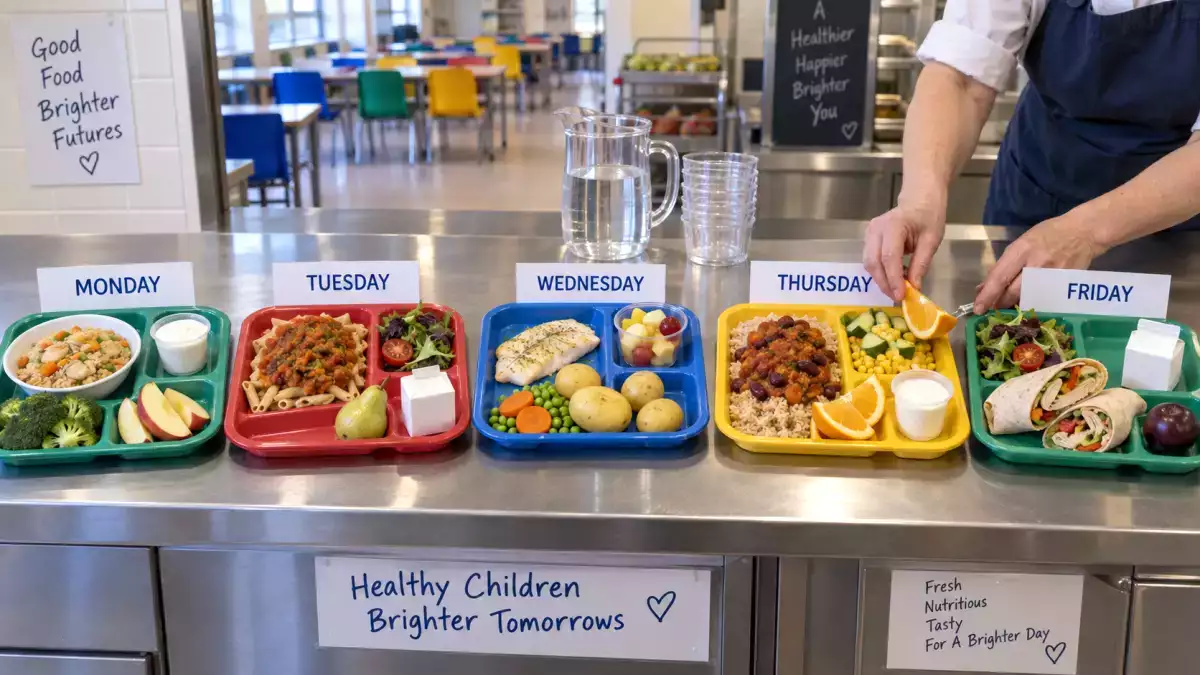
Monday: chicken and vegetable rice bowl, steamed broccoli, apple slices, lower-fat yoghurt and water.
Tuesday: lentil and vegetable Bolognese with wholegrain pasta, mixed salad, pear, milk or a dairy option and water.
Wednesday: baked fish with potatoes, peas and carrots, fruit salad containing at least 50% fruit, and water.
Thursday: bean and vegetable chilli with brown rice, sweetcorn salad, orange wedges, yoghurt and water.
Friday: turkey or vegetarian fajita wrap with salad, seasonal fruit, lower-fat milk and water.
This is not an official menu. It is a practical example of how the standards translate into a varied school week.
Tuesday: lentil and vegetable Bolognese with wholegrain pasta, mixed salad, pear, milk or a dairy option and water.
Wednesday: baked fish with potatoes, peas and carrots, fruit salad containing at least 50% fruit, and water.
Thursday: bean and vegetable chilli with brown rice, sweetcorn salad, orange wedges, yoghurt and water.
Friday: turkey or vegetarian fajita wrap with salad, seasonal fruit, lower-fat milk and water.
This is not an official menu. It is a practical example of how the standards translate into a varied school week.
Why starch variety matters
Starchy foods provide energy and help children feel full. But the standards also ask for 3 or more different starchy foods each week and at least one wholegrain option.
In the sample week, the starches change: rice, wholegrain pasta, potatoes, brown rice and a wrap. That makes the menu more varied and helps prevent the same texture and flavour appearing every day.
The standards also limit starchy foods cooked in fat or oil to no more than 2 days each week across the whole school day, so chips or fried potatoes cannot become the default.
In the sample week, the starches change: rice, wholegrain pasta, potatoes, brown rice and a wrap. That makes the menu more varied and helps prevent the same texture and flavour appearing every day.
The standards also limit starchy foods cooked in fat or oil to no more than 2 days each week across the whole school day, so chips or fried potatoes cannot become the default.
Fruit and vegetables need to appear daily
A school lunch menu needs vegetables or salad every day and fruit every day. Across the week, it should include at least 3 different fruits and 3 different vegetables.
That is why the sample menu uses broccoli, salad, peas, carrots, sweetcorn and mixed vegetables, plus apples, pears, fruit salad, oranges and seasonal fruit.
Fruit-based desserts can help too, but desserts should not replace the need for real daily fruit and vegetables.
That is why the sample menu uses broccoli, salad, peas, carrots, sweetcorn and mixed vegetables, plus apples, pears, fruit salad, oranges and seasonal fruit.
Fruit-based desserts can help too, but desserts should not replace the need for real daily fruit and vegetables.
Protein needs planning, especially for vegetarian meals
The standards require a protein food every day, with meat or poultry on 3 or more days each week, oily fish at least once every 3 weeks, and non-dairy protein on 3 or more days each week.
That means a five-day lunch menu should not treat vegetarian meals as an afterthought. Lentils, beans, chickpeas, eggs, tofu, soya or mycoprotein can help build variety.
One important detail: pulses can count as vegetables, but if they are being used as the non-dairy protein for vegetarian pupils, a separate vegetable serving is still needed.
That means a five-day lunch menu should not treat vegetarian meals as an afterthought. Lentils, beans, chickpeas, eggs, tofu, soya or mycoprotein can help build variety.
One important detail: pulses can count as vegetables, but if they are being used as the non-dairy protein for vegetarian pupils, a separate vegetable serving is still needed.
Dairy and drinks should be simple
A portion from the milk and dairy group should be included every day, and lower-fat milk must be available for drinking at least once a day during school hours.
For drinks, the safest planning principle is simple: water first. Free fresh drinking water must be available at all times, and permitted drinks are limited to options such as water, lower-fat milk, certain calcium-enriched plant drinks and restricted portions of juice or combination drinks.
A menu that depends on sweetened drinks to make lunch appealing is moving in the wrong direction.
For drinks, the safest planning principle is simple: water first. Free fresh drinking water must be available at all times, and permitted drinks are limited to options such as water, lower-fat milk, certain calcium-enriched plant drinks and restricted portions of juice or combination drinks.
A menu that depends on sweetened drinks to make lunch appealing is moving in the wrong direction.
What needs limiting across the week
The standards put clear weekly limits on some foods. Across the whole school day, schools must not serve more than 2 portions of deep-fried, batter-coated or breadcrumb-coated food each week, or more than 2 portions of pastry each week.
They also rule out confectionery, chocolate and chocolate-coated products, and they do not allow salt to be added after food has been cooked.
This does not mean school food has to be plain. It means flavour should come from herbs, spices, garlic, vegetables, fruit and good cooking rather than extra salt, sugar or fried coatings.
They also rule out confectionery, chocolate and chocolate-coated products, and they do not allow salt to be added after food has been cooked.
This does not mean school food has to be plain. It means flavour should come from herbs, spices, garlic, vegetables, fruit and good cooking rather than extra salt, sugar or fried coatings.
How parents can read a menu differently
Parents should look at the week, not just the favourite day. A useful school lunch menu should show colour, variety, protein options, wholegrain or higher-fibre choices and a sensible approach to fried or pastry foods.
It should also be easy to understand. The government expects schools to publish food policies and menus online, which should help parents see whether the week is balanced.
The most useful question is not “does my child like every dish?” but “does the week offer enough good choices for children to eat well?”
It should also be easy to understand. The government expects schools to publish food policies and menus online, which should help parents see whether the week is balanced.
The most useful question is not “does my child like every dish?” but “does the week offer enough good choices for children to eat well?”
The takeaway
England’s new school food standards make the five-day lunch menu more important than any single plate. A good week needs daily fruit and vegetables, daily starch, daily dairy, protein variety, water and sensible limits on fried, pastry and sugary foods.
For menu planners, the challenge is to make those rules feel like real meals children want to eat: pasta, curries, rice bowls, wraps, baked fish, chilli and colourful sides.
The best school lunch menu is not only compliant. It is varied, filling, understandable and enjoyable enough for pupils to choose it.
For menu planners, the challenge is to make those rules feel like real meals children want to eat: pasta, curries, rice bowls, wraps, baked fish, chilli and colourful sides.
The best school lunch menu is not only compliant. It is varied, filling, understandable and enjoyable enough for pupils to choose it.
 Juliette Hess
I have been creating culinary content for Petitchef since 2017.
I love travelling and discovering new dishes, trying out new food trends and exploring new restaurants.
I’m a huge fan of pasta and noodles in all their forms ❤ from udon noodles to tagliatelle, I love cooking them and even making them from scratch!
I’m currently preparing, filming and photographing your next recipe, and I hope you’ll enjoy it!
I love travelling and discovering new dishes, trying out new food trends and exploring new restaurants.
I’m a huge fan of pasta and noodles in all their forms ❤ from udon noodles to tagliatelle, I love cooking them and even making them from scratch!
I’m currently preparing, filming and photographing your next recipe, and I hope you’ll enjoy it!
Comments