Why you should cool a saucepan of leftovers before refrigerating: smarter, safer kitchen habit
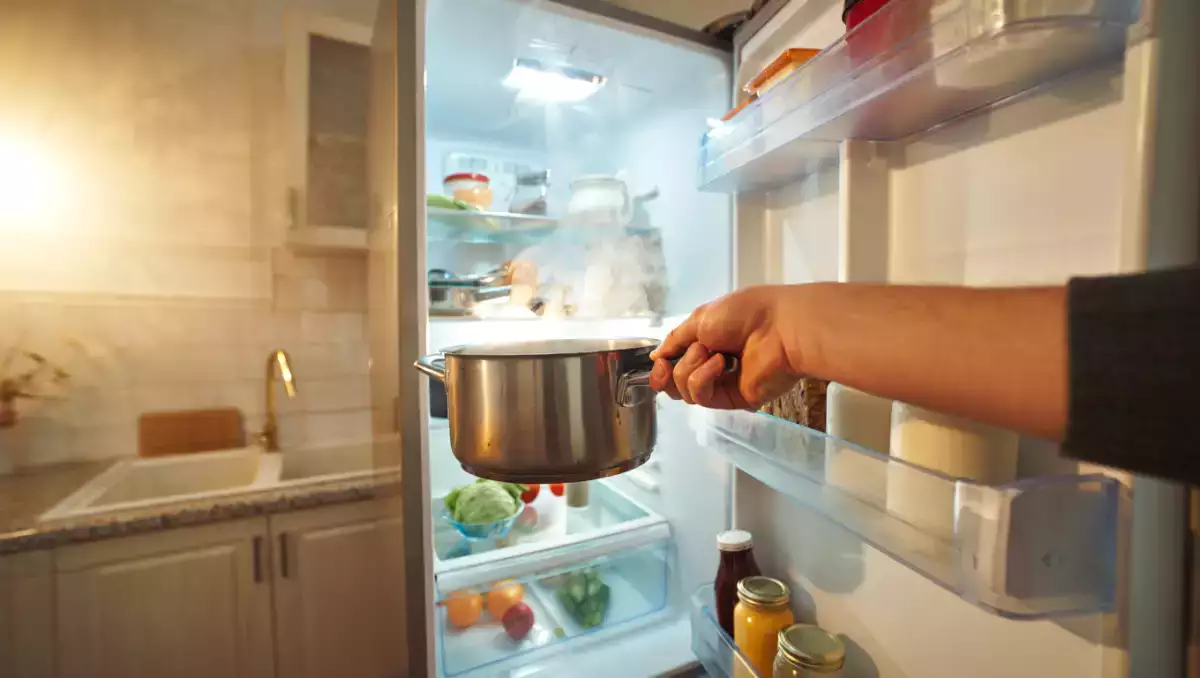
Dinner's over and you don't feel like messing up an extra can... so hop, hop, the whole pot goes straight into the fridge.
Convenient, quick and effortless.
Except that this habit isn't necessarily ideal for food preservation... or for certain cooking materials.
Leaving a dish in a saucepan or frying pan for several hours, or even overnight, prolongs the contact between the food and the cooking material. And depending on the utensil used, this can pose a number of problems.
The first problem: metal migration in foods
Stainless steel, aluminum, copper or cast-iron pans can release very small quantities of metals into food.
Nothing to worry about when you're cooking normally: during cooking, contact remains relatively short.
But when a dish is stored for hours in the fridge in the same container, this contact lasts much longer.
And some foods are even more conducive to this phenomenon.
This is particularly true of acidic preparations such as :
- Tomato sauces
- Lemon dishes
- Vinegar recipes
- Marinades
- or certain highly acidic stews
Acidity can accelerate the migration of metal particles in food.
Stainless steel: solid... but not totally neutral
Stainless steel remains one of the most stable and safest materials in the kitchen.
But "stainless" does not mean totally inert.
Stainless steel contains chromium and often nickel.
In the vast majority of cases, the quantities released remain very low and harmless to the general population.
But some people sensitive to nickel may be more reactive, especially with prolonged and repeated contact.
And the older, scratched or poor-quality the utensil, the greater the risk of migration.
Aluminium: more sensitive to acidic foods
Aluminum is a little more problematic.
This metal reacts much more readily with acidic or salty foods.
This is why we often advise against letting tomato sauce cool directly in an aluminum pan for hours.
The aluminum can then migrate further into the dish.
Today, many aluminum pans have a protective coating that limits this phenomenon... but when the coating is damaged, exposure increases.
And cast iron?
Even cast iron is affected. Cast-iron casseroles can release iron into food, especially with highly acidic dishes.
In fact, some people deliberately use this effect to slightly increase their iron intake.
But then again, it's not necessarily worth prolonging contact overnight in the fridge.
The second problem: non-stick coatings
And a lot of people are concerned.
Because non-stick pans are everywhere in our kitchens.
Teflon, PTFE, "stone effect", "ceramic effect" coatings...behind the marketing promises, these pans often rely on technical layers that can become brittle over time.
During cooking, especially at high temperatures or when the coating is scratched, tiny particles can already be released.
So obviously, storing a cold dish for a few hours has nothing to do with aggressive cooking.
But the problem remains the same: why unnecessarily prolong contact between food and a weakened coating?
There's also a real cooling problem
Apart from the materials involved, leaving a whole pan in the fridge also poses a practical problem.
Large pans cool much more slowly than a dish transferred to a shallow container.
As a result, food stays longer in the famous "danger zone" between 50°F/10°C and 145°F/63°C, the ideal temperature for bacterial growth.
And the slower the cooling, the greater the microbiological risk.
So, does it matter if you've already done it?
Of course not!
Exceptionally putting a pan in the fridge overnight won't cause a catastrophe.
It's more a question of the precautionary principle and good habits to adopt on a daily basis.
Because between materials, coatings, microplastics and food preservation... it's simply better to avoid unnecessary contact when the solution is as simple as an airtight box.
 Adèle Peyches
Comments