Why top chefs cook white asparagus in a bundle?
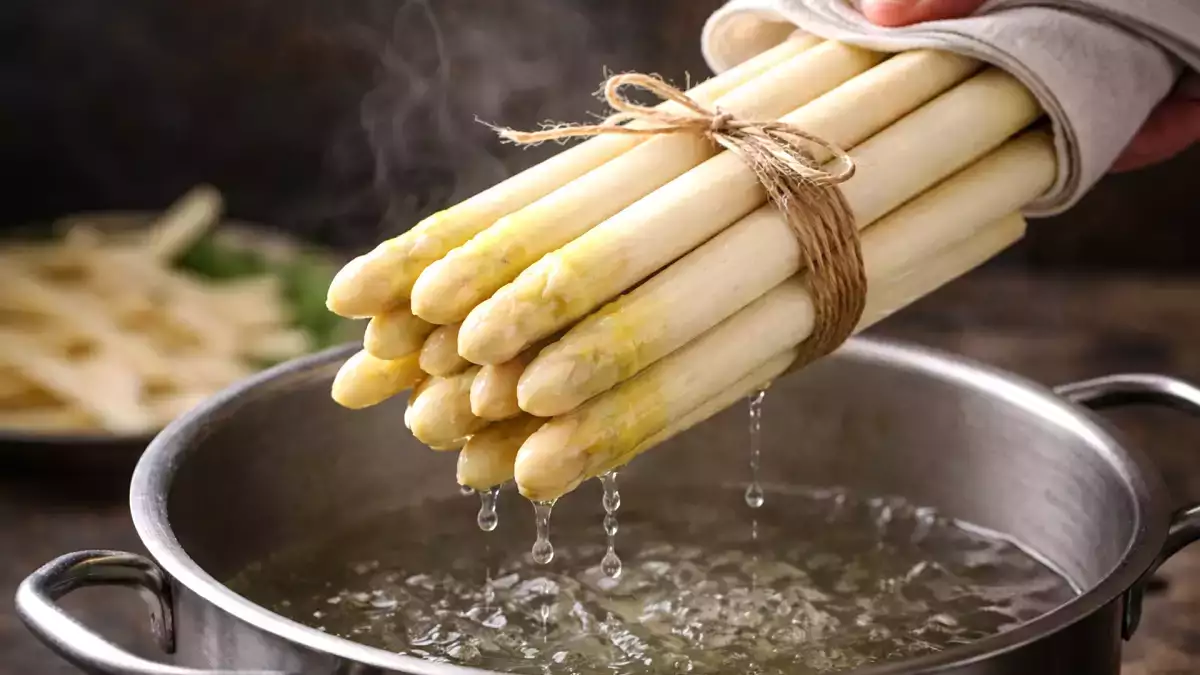
The first time someone sees white asparagus tied with kitchen twine, they usually think it is a gesture made "because it looks nice". It's a trade habit, a restaurant detail. Then you taste them: tender, straight, with the tip intact. And you understand that cooking white asparagus in bunches is not a whim. It is a simple and effective technical solution to treat a delicate product without mistreating it.
White asparagus, already peeled and ready to cook, requires care. Not because it is fragile in the romantic sense of the word, but because it easily breaks, bends and gets out of shape, especially in the thinnest part. If you handle it badly, it loses exactly what makes it special: a clean texture, without fibers, and that mellow point that only appears when the cooking is well adjusted.
Tying it in a bunch is, in fact, a way of cooking with control. When a dish is based on such a sober ingredient as white asparagus, the luxury is not to add things: the luxury is that it comes out perfect.
White asparagus, a highly appreciated product
White asparagus is the same as green asparagus, but grown without light. This detail changes the game: less herbaceous flavor, more delicacy, more importance of texture. Here there is no sauce that fixes a careless cooking. If it is stringy, it shows. If the tip falls apart, too.
In professional cooking there is a more than justified respect for this product and a shared obsession: that all the asparagus in a portion should be the same. That the diner does not notice that one is perfect and another "has become hard". This search for uniformity explains a large part of the technique.
The bouquet is not aesthetics: it is three advantages of real cooking
1) Protects the asparagus at its most vulnerable moment.
Once peeled, the asparagus loses its "armor": the outer layer that used to protect it (and which, moreover, could be fibrous) is no longer there. From then on, any blow against the pot, a sharp turn or the classic "I'll take it out with the ladle" can break it right where it is most noticeable: in the upper third, near the tip.
When you tie them together, they are no longer loose pieces that move, cross and hit each other. They start to behave as a single unit: they pull in, pull out, slip out and move with more control.
An important detail: try to use asparagus of similar caliber so that the cooking time is comparable and the result is uniform.
2) Keeps the shape and helps to cook more evenly
In a large pot, loose asparagus will float, bend, bunch or change position. The result is predictable: some pieces are done a little earlier, others a little later, and the texture is less uniform.
The bouquet keeps them aligned, with the bases at the same height. And that matters: the base, which is thicker, needs more time than the part near the tip. The more constant the position during firing, the easier it will be to nail the end point.
3) Makes it easier to treat the tips more carefully
The tip is the first part that can be overdone and the last part to be mistreated. In the classic technique - especially with asparagus, which allows vertical cooking - the stems are more submerged, while the tips receive a gentler heat. In practice, the upper part is cooked with the help of steam and the warmer water on the surface, which reduces the risk of the tip falling apart while the stem finishes cooking.
Here the bunch does not "look pretty": it makes it possible to keep the whole thing tidy and upright. Without tying, that position breaks down easily and control over the tips is lost sooner.
The corsage also aids in service
In a restaurant (and also at home, if we are looking for a fine result), white asparagus rarely goes from the water to the plate without steps: cooking, draining, drying, resting, gentle regeneration, sauce and plating. The bouquet makes this journey cleaner and less abrupt.
And there is a detail that seems minor until you see it in the pass: drain well. A wet white asparagus is lackluster, cools the dish and weakens any sauce. Tied, they drain and dry better, almost as if they were one piece.
How to make asparagus bundle at home
Once peeled and cleaned, form a compact bundle, but do not strangle them. Align the bases (so that they are at the same height), put the asparagus together in a cylinder and tie it with kitchen string at two points: one halfway up and the other near the base.
Tighten just enough so that they do not get messy during cooking, leaving a margin so that the asparagus does not mark or break when handled. If you are going to cook vertically, make sure that the tips are free and without knots on top, so that they receive the heat more gently and reach the plate whole.
 Patricia González
Comments