11 psychological tricks restaurants and beach bars use to make you spend more: how to spot them
1. The anchor item: an expensive product that makes everything else seem reasonable
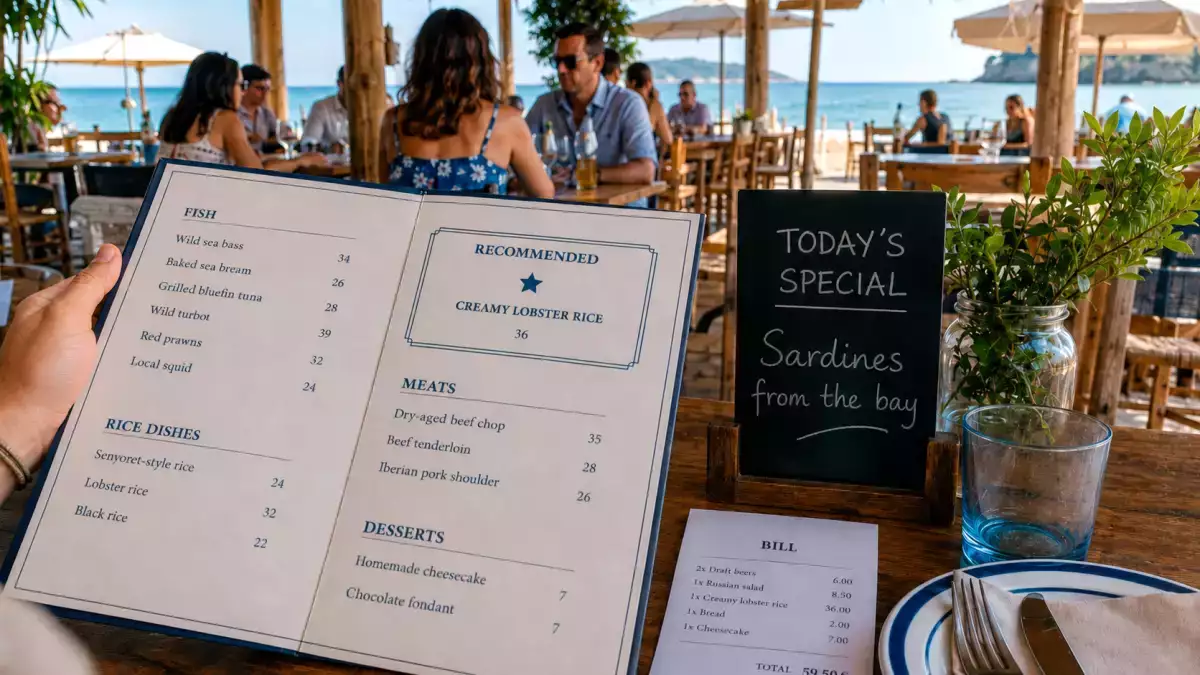
Many restaurants list a very expensive dish (a premium rice dish, wild sea bass, a seafood platter, or a ribeye steak for two) to create a point of reference. Even if you don’t order it, that price makes other dishes priced at 22 or 28 euros seem more reasonable. In behavioral economics, this is related to anchoring and aversion to extremes: many people avoid both the cheapest and the most expensive options and end up choosing something in between.
How to spot it: Look for the clearly most expensive item in the category and ask yourself if it’s there because of actual demand or as a psychological reference point. At beach bars, it often appears in fish sold by weight, specialty rice dishes, or “sharing platters.”
2. Prices without the euro symbol: when money seems like less money
One of the best-known techniques is to present prices as “14” or “14.50,” without the “€” symbol, without aligned columns, and sometimes using a less eye-catching font than the dish’s name. The idea is to reduce the perception of cost and prevent customers from treating the menu as if it were a price list. Cornell’s research on menu pricing formats specifically analyzed whether the way prices are presented affects purchasing behavior in restaurants. Its main conclusion was that formats without a currency symbol may be associated with higher bills in certain contexts, though this should not be interpreted as a universal rule for all establishments.
How to spot it: If, when you open the menu, you have trouble finding the prices or comparing them across dishes, the design is likely intended to make you choose based on desire rather than cost.
Practical tip: Read the entire category first, identify the price range, and set a mental limit before letting yourself be swayed by the description.
3. The lure option: three sizes or versions to target the mid-water column
The trap appears when there are three options: small, medium, and large; a glass, a pitcher, and a bottle; a small portion, a half portion, and a full portion. The middle option usually seems like the most sensible choice, even though it might not be the one you would have chosen if there were only two options.
How to spot it: Compare price per quantity, not just the price difference. If the large portion seems “just a little more expensive” but means ordering more than you need, the savings may be illusory. When dining in a group, check how many actual units each size includes.
4. Sensory descriptions: selling the dish before you taste it
Words like “crispy,” “sweet,” “grandma’s recipe,” “freshly made,” “marinated,” “low-temperature,” “from the harbor,” or “homemade” trigger expectations. Studies on descriptive labels have found that the most evocative names can boost sales and improve how the dish is rated afterward. This doesn’t mean the product is fake; it means that language changes perception before the first bite.
How to spot it: Separate useful information from emotion. “Smoked sardines with seasonal tomatoes” provides facts; “the most irresistible sardines of the summer” is persuasion. Ask about size, side dish, cooking method, or origin if the price depends on that promise.
5. Boxes, highlights, and “recommended by the house”: the eye doesn’t wander at random
Menu engineering analyzes which dishes sell best and which generate the highest profit. Based on this data, the restaurant can highlight the items it wants to promote using boxes, icons, colors, photographs, “specialty” labels, or particularly prominent placements on the menu. Eye-tracking studies and research on menu design show that presentation influences where the eye travels, although there is no single reading pattern that applies to all customers.
How to spot it: When a dish is framed, recommended, or repeated across multiple platforms (the menu, the chalkboard, the QR code, or the outdoor sign), ask yourself if it’s the best option for you or simply the most profitable one for the restaurant. You don’t have to rule it out: compare it with a couple of alternatives that aren’t highlighted.
6. Short menus and closed categories: less effort, faster ordering
A concise menu can be a sign of focused cuisine and fresh ingredients, but it also helps speed up the decision-making process. When options are organized into very clear categories—“appetizers,” “to share,” “must-tries,” “seafood,” and “desserts”—the customer follows a predictable path.
Research on choice overload is nuanced:
- too many options can be exhausting, but
- too few options can also strongly influence the decision.
How to spot it: see if the menu guides you through a natural sequence: appetizer, main course, side dish, drink, dessert. Before ordering, decide whether you really want to go through all the courses or if a simpler combination will suffice.
7. Separate sides: the dish looks cheap until you add the sides
An attractive base price may not include bread, a side dish, sauce, a patio surcharge, service charge, toppings, special ice, a beverage, or a side. This technique isn’t always misleading—sometimes it allows for customization. But in practice, it drives up the bill because customers compare the price of the incomplete dish and end up accepting small extras that seem insignificant on their own.
How to spot it: Calculate the final price of what you’re actually going to eat. At beach bars, pay special attention to bread, cover charge, potatoes, side salads, sauces, ice, terrace surcharges, prices by weight, and whether VAT is included. The key question is: “What exactly is included?”.
8. Waiter's suggested sale: the recommendation that increases the average check
Upselling is a professional service technique in which the server recommends something else to you: a specific drink, a shared appetizer, a dessert, a specialty coffee, or a more expensive option. When done well, it can be helpful because the staff knows the menu and can assist you in making a choice. The problem arises when the recommendation turns into pressure to spend more.
How to spot it: Pay attention to whether they’re offering you a choice or assuming you’ll order it. It’s not the same to ask, “Would you like dessert?” as it is to say, “I’ll bring you a cheesecake to share, right?” If you’re not interested, respond clearly: “Thanks, just this for now.”
9. Beverages, cocktails, and food pairings: the liquid margin
Beverages are often a key driver for increasing sales: appetizers, wine by the glass, sangria, pitchers, cocktails, specialty coffees, or food-and-drink pairings. The National Restaurant Association notes that alcoholic beverages and beverage programs have become increasingly important as drivers of sales and the overall dining experience. In beach areas, the combination of heat, waiting time, music, and social drinking can lead to a second round almost automatically.
How to spot it: Check the price per glass, pitcher, or bottle and decide in advance whether there will be one or two rounds. When they suggest “something refreshing to start,” remember that an appetizer can double the cost of a simple meal.
10. Designed atmosphere: music, lighting, and rhythm to slow down or speed up the game
The atmosphere also plays a role. Both classic and recent studies on background music in restaurants have examined how tempo can influence the length of a customer’s stay, the bill total, and beverage consumption.
Lighting, music volume, chair comfort, and table layout also influence the experience. All these elements can make a meal feel more relaxed or more rushed and, as a result, affect how long we stay at the restaurant and what we end up ordering.
How to tell: if the music is slow, the lighting is warm, and the table is comfortable, you may be in an environment designed to encourage you to linger over your meal. If there’s a high turnover, bright lighting, and loud noise, the goal may be the opposite: quick decisions and empty tables. In both cases, take your time ordering and check whether you’re still eating because you’re hungry, thirsty, or simply out of habit.
11. Scarcity, urgency, and the “today’s special”: when the fear of missing out decides for you
“Last few servings,” “off the menu,” “just in,” “today only,” “we have two sea bass left,” or “the rice is coming out now” are very effective messages because they reduce the time customers spend thinking. They may be entirely true, especially at restaurants serving fresh produce. They can also act as urgency triggers, prompting customers to make a quick decision and accept a price that’s less open to comparison.
How to spot it: Always ask for the price before ordering an off-menu item, especially if it’s fish, seafood, premium meat, or made-to-order rice. A transparent recommendation includes the price, approximate portion size, and how many people it’s intended to serve.
How to stay safe without giving up the fun
 Patricia González
Comments