Avoid botulism in summer preserves: essential jar safety tips every home canner should know
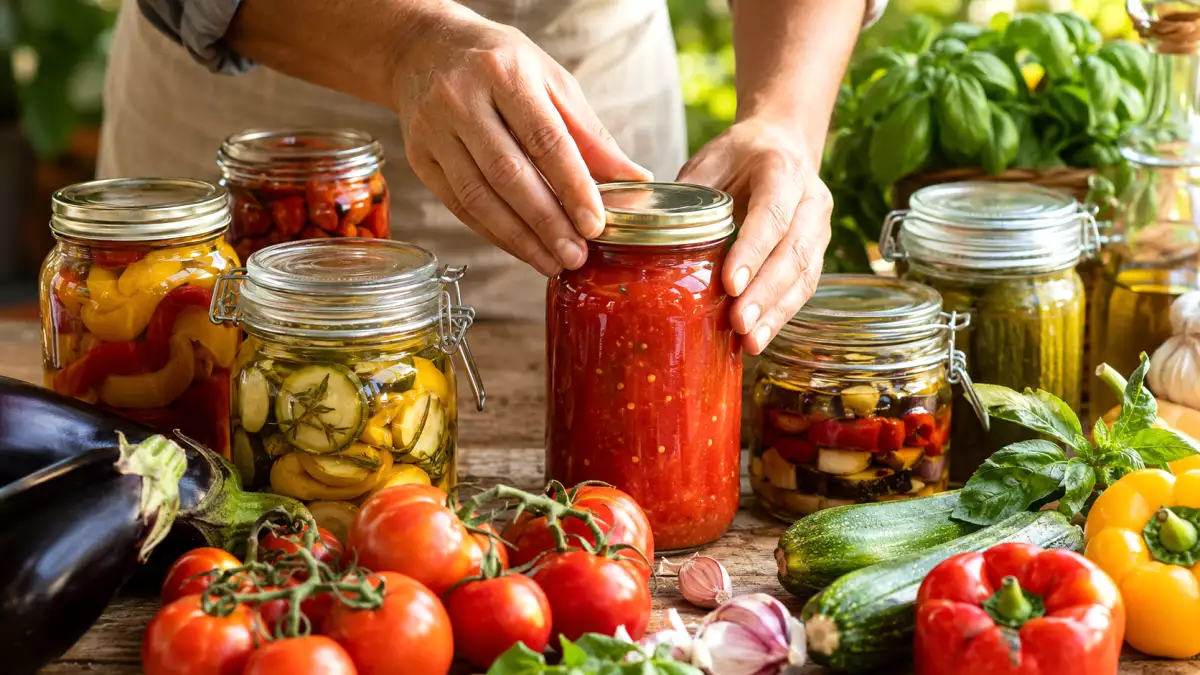
Summer fills the garden with tomatoes, eggplants, zucchini, and bell peppers. And when the harvest is bountiful, the temptation to preserve it all in jars is practically irresistible.
Making homemade summer preserves is a great way to avoid food waste and bring the flavors of summer to the table even during the winter. Between a batch of tomato sauce and a jar of eggplant in oil, however, you need to be careful about botulism.
Foodborne botulism can be very serious. There are no secret tricks to avoiding it: all you need is good hygiene, reliable recipes, and a few rules to follow without improvising.
Why can botulism develop in canned foods?
The bacterium that causes botulism may be present in the soil and, consequently, on the surface of fruits and vegetables as well.
Its spores can grow in environments:
- oxygen-free;
- moist;
- slightly acidic;
- stored at room temperature.
A hermetically sealed jar can therefore become a favorable environment, especially when it contains vegetables that have not been properly acidified.
In fact, oil does not eliminate the risk. By completely covering the food, it reduces the presence of oxygen, but for this very reason, the vegetables must be prepared and acidified properly before being jarred.
How can you avoid botulism in homemade preserves?
The first rule is not to arbitrarily change the amounts specified in the recipes. Vinegar, salt, and sugar aren’t just for flavor—they also help ensure the safety of the preserves.
When making homemade preserves, it’s important to:
- wash your hands, utensils, and work surfaces thoroughly;
- use fresh, healthy fruits and vegetables with no bruised parts;
- choose unbroken jars and lids in good condition;
- follow reliable recipes without reducing the amounts of vinegar, salt, or sugar;
- properly acidify vegetables intended for oil-preserving;
- Pasteurize the jars according to the recipe’s instructions;
- Store them in a cool, dry place away from light;
- Check periodically to ensure the vacuum seal is still intact.
Washing and boiling the jars is important, but it’s not enough. Safety depends on the entire process, from preparing the ingredients to the final sealing.
How can you safely prepare pickled vegetables?
Eggplant, zucchini, bell peppers, and mushrooms preserved in oil are among the most popular summer preserves, but they require special care.
Before being placed in jars, the vegetables must be washed, cut, and acidified. They are typically blanched for a few minutes in a solution of water and vinegar, following a proven recipe.
After being drained and dried, they can be placed in jars and completely covered with oil. No parts of the vegetables should remain exposed to the air.
Reducing the amount of vinegar because its flavor seems too intense is not a good idea. The specified amount is not merely a matter of taste but a safety measure.
Adding garlic, herbs, or chili peppers without following a specific recipe can also alter the characteristics of the preserves. You can be creative in the kitchen, but with vegetables preserved in oil, it’s best to save improvisation for when you serve them.
How long do the jars need to be boiled to prevent botulism?
There is no single boiling time that applies to all preserves. The duration of the pasteurization process for jars depends on the type of food, the acidity level, the size of the container, and the procedure specified in the recipe.
For jars of about 12-14 oz/350–400 grams containing properly acidified vegetables, 15–20 minutes of boiling may be sufficient. Jars that have already been filled and sealed must be completely submerged in water; the indicated time should be counted once the water has reached a boil. Larger jars or different preparations require specific times, so it is essential to follow a reliable recipe rather than relying on a randomly chosen duration.
Before filling the jars, vegetables intended for oil-preserves must be properly acidified. The ISS guidelines call for cooking the vegetables in a solution of equal parts water and vinegar, followed by filling the jars, adding oil if desired, and pasteurizing the sealed jar.
It is important to remember that boiling the jars for a longer time cannot make a poorly prepared preserve safe. Normal boiling reaches temperatures close to 212°F/100 °C and does not guarantee the destruction of botulinum spores. Safety depends on a combination of factors:
- proper acidification of the food;
- an adequate amount of salt or sugar;
- adherence to the recipe’s measurements;
- proper filling and sealing;
- heat treatment appropriate for the product and jar size.
Low-acid preserves, such as those made with meat, fish, and certain plain vegetables, require true sterilization at approximately 249°F/121°C under pressure—a condition that cannot be achieved with a standard household pot. For this reason, simply boiling the jars is not sufficient, and such preparations should not be stored in the pantry using improvised methods.
Which preserves are best not to make at home?
Not all foods can be preserved in the pantry simply by boiling them.
Low-acid foods, such as canned meat, fish, meat sauces, and some plain vegetables, require processing at temperatures that are difficult to achieve with standard household pots and pans.
For these recipes, the safest approach is to prepare small portions and freeze them.
Even homemade pesto shouldn’t be left at room temperature for long. It’s best to divide it into small containers and store it in the freezer.
How can you tell if a canned food product contains botulinum toxin?
Contaminated canned food does not always have an unusual smell or appearance. For this reason, it is not possible to determine with certainty whether a product is safe simply by looking at it.
However, there are certain signs that should immediately raise a red flag:
- a swollen lid;
- a lid that makes a “click-clack” sound when pressed;
- liquid leaking;
- bubbles rising from the bottom;
- cloudy oil;
- unusual color or consistency;
- foul odor;
- absence of a vacuum seal.
If any of these signs are present, the jar should not be consumed.
The rule is simple: don’t even test a suspicious jar with the tip of a spoon. Tasting a small amount is not a reliable way to check if it’s still good.
How can I tell if the vacuum seal was successful?
After cooling, the center of the lid should appear slightly sunken and should not move when pressed.
If the lid makes the classic “click-clack” sound, the vacuum seal has not formed properly. In this case, the jar should not be stored in the pantry as if nothing were wrong.
It’s also helpful to label each jar with the name of the contents and the date. In addition to keeping your pantry tidier, this helps ensure that older jars are used up first.
How long do opened jars of preserves last in the refrigerator?
Once opened, the jar should be stored in the refrigerator immediately and consumed as soon as possible.
To avoid leaving an open container sitting for weeks, it’s best to use small jars that are suitable for the amounts you normally consume.
The food must remain submerged in the preserving liquid. If the color, smell, or texture changes after opening, it’s best to discard it without tasting it.
When it comes to summer preserves, don't wing it
Making safe summer preserves doesn’t mean giving up your family recipes. It means using fresh ingredients, following the correct measurements, and adhering to reliable procedures.
Purees, jams, and vegetables preserved in oil can keep the scent of summer alive even during the coldest months. Just remember that when it comes to botulism, you can never be too careful.
And above all: if a jar doesn’t look right, don’t taste it out of curiosity. Throw it away without hesitation.
 Leandra Masha
Comments