Dishwasher Eco Cycle takes forever? Why it can still lower your bills
Thursday 5 November 2026 15:30 - Mirella Mendonça
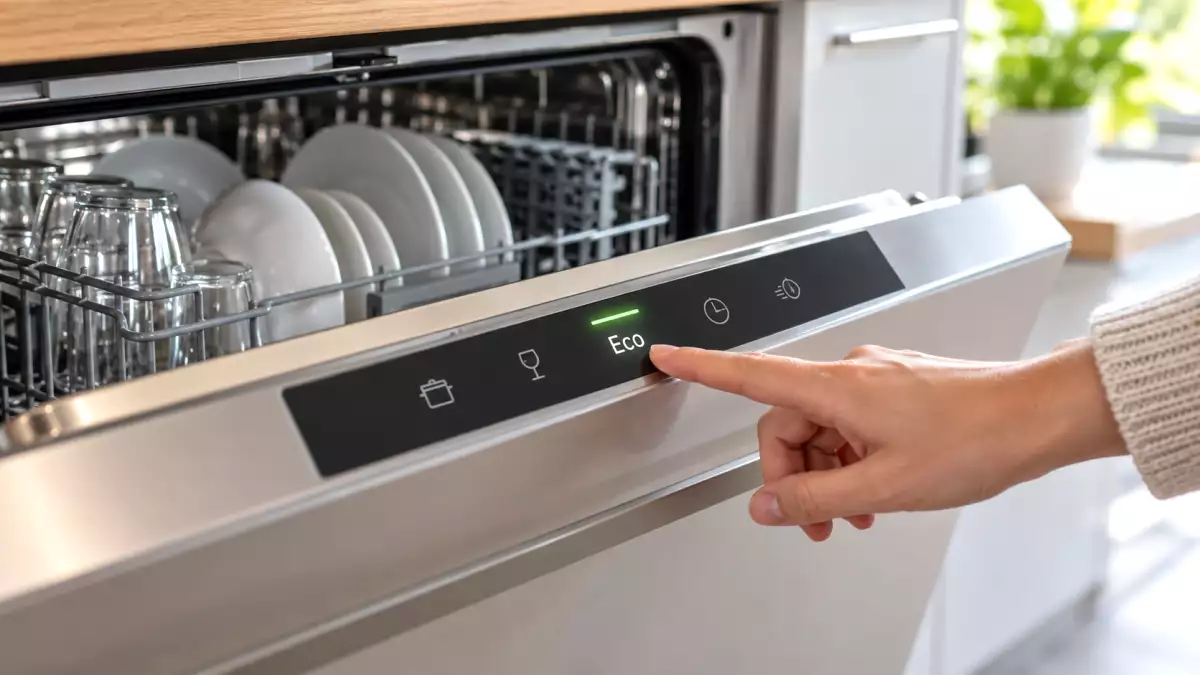
On many models, Eco or Energy Saver mode uses less hot water and carefully extends certain washing stages so detergent has time to work. That can cut energy consumption for normal daily dishes. But your actual savings depend on the appliance, load and local electricity rate—so the most useful strategy is to compare your machine's settings rather than trust the timer alone.
Does the Eco cycle actually use less energy?
Often, yes. Eco is typically designed to clean normally soiled dishes using an efficient combination of temperature, water and wash duration. A shorter cycle may require more intensive heating or spraying, although this varies by model.
Don't compare a full Eco wash with a rinse-only setting or a Quick cycle intended for very lightly soiled dishes. To make a fair comparison, consider similar loads and cleaning needs.
Don't compare a full Eco wash with a rinse-only setting or a Quick cycle intended for very lightly soiled dishes. To make a fair comparison, consider similar loads and cleaning needs.
Eco vs. Quick, Auto, Normal and Heavy
Eco/Energy Saver: Often prioritizes lower consumption at the expense of time.
Quick/Express: Prioritizes speed; it may use more energy for a comparable load, but not always.
Auto/Sensor: Adjusts water and washing based on soil sensors. Sometimes it will be more efficient than Eco.
Normal: Intended for everyday dishes and sometimes already optimized for energy efficiency.
Heavy/Pots & Pans: Designed for tougher, baked-on food and may use more energy and water.
Cycle names and performance differ by manufacturer, so your owner's manual is the deciding reference.
How much could you save in dollars?
Here's an illustrative calculation, not a promise of savings on any particular U.S. model. Suppose Eco consumes 0.65 kWh per cycle and a hotter, faster full wash consumes 1.30 kWh. If you wash dishes four times a week (208 cycles a year) and pay $0.16 per kWh, annual electricity costs would be about $21.63 for Eco versus $43.26 for the other cycle.
That's approximately $21.63 saved annually in this example. For your own calculation, use (other-cycle kWh − Eco kWh) × annual loads × your electricity rate. Your actual bill also reflects other factors, and these figures exclude water, sewer and detergent costs.
That's approximately $21.63 saved annually in this example. For your own calculation, use (other-cycle kWh − Eco kWh) × annual loads × your electricity rate. Your actual bill also reflects other factors, and these figures exclude water, sewer and detergent costs.
Why does a slower cycle save electricity?
A substantial share of dishwasher energy goes toward heating water. Many Eco programs use a lower wash temperature or smaller volume of water, then allow a longer period for cleaning. The heater isn't running at full power throughout the entire program.
So time running isn't the same as energy consumed. A longer cycle can require less total electricity than a short, hot cycle, although the result depends on the dishwasher.
So time running isn't the same as energy consumed. A longer cycle can require less total electricity than a short, hot cycle, although the result depends on the dishwasher.
Does Eco mode save water, too?
Frequently, but not universally. An automatic sensor program can sometimes use less water than Eco for a lightly soiled load. For U.S. context, ENERGY STAR's current standards for qualifying standard-size dishwashers specify no more than 3.2 gallons per cycle and 240 kWh per year under prescribed tests.
Those are appliance certification thresholds, not measurements for every Eco setting. Look up your dishwasher's cycle-specific water consumption for a meaningful comparison.
Those are appliance certification thresholds, not measurements for every Eco setting. Look up your dishwasher's cycle-specific water consumption for a meaningful comparison.
When Eco isn't the best choice
Use the mode that gets dishes clean the first time. Burned-on casseroles, very greasy cookware or stubborn residue may call for Heavy wash. If an Eco cycle fails and you need to wash everything again, you can lose much of the intended savings.
Quick is practical when time matters and your dishes meet that setting's instructions. For ordinary daily dishes, Eco—or your manufacturer's recommended efficient Normal cycle—is a sensible starting point.
Quick is practical when time matters and your dishes meet that setting's instructions. For ordinary daily dishes, Eco—or your manufacturer's recommended efficient Normal cycle—is a sensible starting point.
Can using Eco all the time damage the dishwasher?
A longer cycle doesn't automatically wear out the heating element: dishwashers are designed to operate their built-in programs. But regular cleaning and maintenance still matter, especially if you commonly use lower-temperature programs.
Clean the filter, check the spray arms, follow any recommended machine-cleaning routine and adjust detergent or water-softening settings according to your owner's manual.
Clean the filter, check the spray arms, follow any recommended machine-cleaning routine and adjust detergent or water-softening settings according to your owner's manual.
How to check your own dishwasher's savings
In the U.S., look for the yellow EnergyGuide label, which provides estimated yearly energy cost under standardized assumptions. ENERGY STAR certification identifies models meeting efficiency requirements.
Neither label automatically tells you the electricity used by each setting. For Eco versus Quick versus Heavy, consult the model-specific manual or manufacturer's consumption chart, if available. Multiply the listed kWh per cycle by your electricity rate and annual number of loads.
Neither label automatically tells you the electricity used by each setting. For Eco versus Quick versus Heavy, consult the model-specific manual or manufacturer's consumption chart, if available. Multiply the listed kWh per cycle by your electricity rate and annual number of loads.
Small habits that improve savings
Scrape instead of pre-rinsing: Remove large food scraps without washing every plate under running water.
Run full, properly spaced loads: Avoid overcrowding and blocking spray arms.
Use the appropriate detergent amount: Too much isn't necessarily better.
Clean filters and spray arms: Better cleaning reduces the risk of repeat cycles.
Skip heated dry when practical: If your model offers this option, check whether disabling it can lower consumption.
Frequently asked questions
Why does Eco take so long?
It may use less-hot water and give detergent more time to work.
Is Quick always less efficient?
No. It depends on the machine, load size and soil level.
Will Eco always save water?
No. A sensor-driven mode can sometimes use less water.
Does EnergyGuide show Eco-only costs?
No. It provides an overall annual efficiency estimate under standardized conditions.
The bottom line
A longer dishwasher cycle can still be the cheaper one. For normally soiled dishes, Eco is often worth using because it manages water and heat more efficiently. But the smartest choice is the one that cleans properly the first time while using the fewest resources for that load.
Check your machine's manual, avoid unnecessary pre-rinsing and don't assume that the shortest cycle is automatically the least expensive.
Check your machine's manual, avoid unnecessary pre-rinsing and don't assume that the shortest cycle is automatically the least expensive.
 Mirella Mendonça
I am the editorial manager at Petitchef (Portugal and Brazil) and a huge enthusiast of travel and world cuisine, always in search of new flavors and experiences. However, as much as I love exploring the delights of different cultures, my mom's cooking will always be my favorite — with that unique flavor that only she can create.
Comments