How should risotto be served in a deep or shallow plate? The debate that even divides chefs
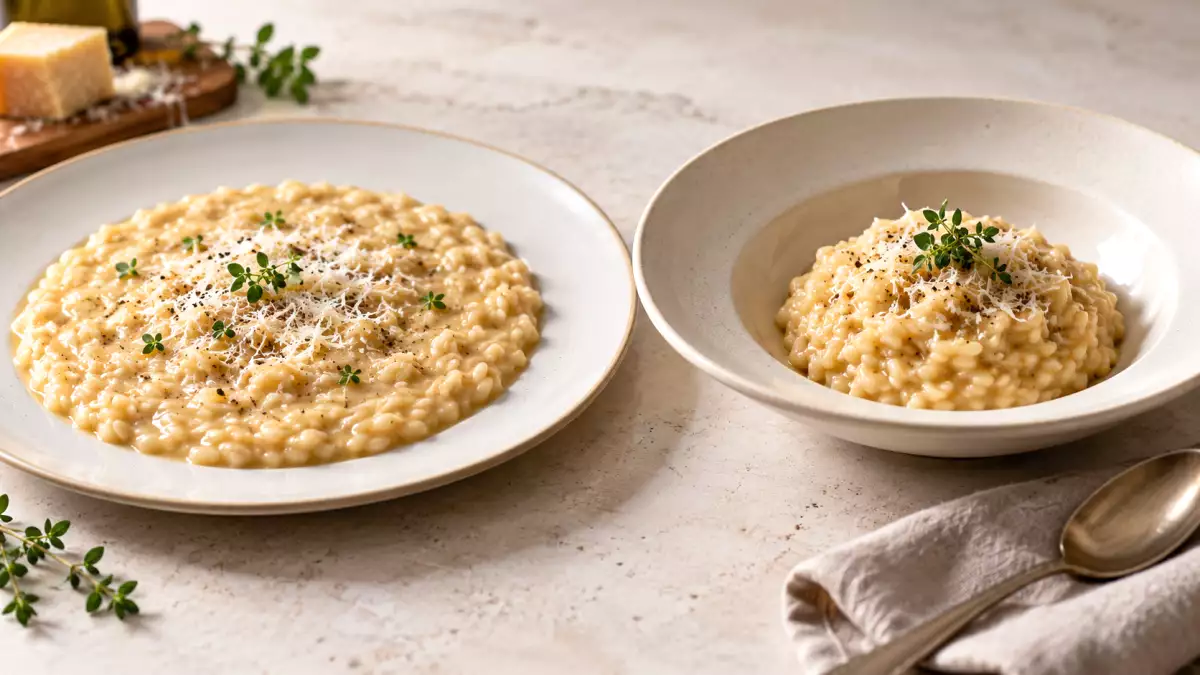
You’ve made a creamy risotto, turned off the heat at just the right moment, and already you can hear someone asking, “Are you going to serve it in a deep dish?”
Some people swear by the shallow dish because it showcases the “wave” of the rice, while others would never give up the deep bowl, which catches every bite. The truth? How you serve risotto depends on its consistency, temperature, and even the time it takes to get from the kitchen to the table.
Should risotto be served on a flat plate or a soup bowl? What does etiquette say?
The right question, then, isn’t “which plate is allowed?” but which plate best showcases the risotto you’ve cooked. And this is where the real star of the show comes in: the stirring process.
Why does "risotto all'onda" look so good on a flat plate?
The advantage isn’t just aesthetic. The thinner layer allows you to appreciate the individual grains and distribute the ingredients evenly across the surface. However, there’s a downside: more exposed surface area means the risotto tends to cool down faster. If your guests are already seated, that’s perfect. If they’re still on their way, not so much.
When to choose a deep plate: it's not a mistake
Be careful, though: a very narrow deep plate creates a central mound and can hide the texture, as well as making it harder to distribute the sauce evenly. The best compromise? A plate with a wide rim and a slightly concave center—wide enough to show off the wave without risking spills.
How to plate creamy risotto without ruining It
- Stir in the butter and cheese (if called for) with the heat off, taking care not to dry out the rice too much.
- Check the consistency: when you swirl the pot, the risotto should fold back on itself—it shouldn’t stick to the sides.
- Warm the plates: this prevents the cold ceramic from immediately drawing heat away from the dish.
- Serve moderate portions: it’s better to leave some space around the rice than to pile it up into a pyramid.
- Bring it to the table immediately: the rice continues to absorb liquid even after cooking.
How to tell if risotto is too dry or too watery
Don’t confuse creamy with watery, though: the “wave” isn’t a swimming pool. And not all risottos need to have the same consistency; some regional recipes favor a firmer texture.
Does the dish also affect the taste? And the temperature?
For this reason, with a rich and full-bodied risotto, you might prefer a deep bowl; with a very fluid dish—perhaps delicate and citrusy— a shallow dish highlights its movement. There are no rules, just sensible choices.
What kind of dish should you serve with a delicate, creamy, or seafood risotto?
Here’s a little experiment you could try: divide the same dish into two portions, serve one on a flat plate and the other in a bowl. After a minute, compare the temperature, distribution, and creaminess. The result might even change the mind of the most ardent advocate of the single-plate serving.
Do you eat it with a fork or a spoon?
At home, of course, everyone has their own habits, but it’s interesting that the choice of cutlery is much more codified than that of the plate.
In the end, it's the risotto that wins, not the dish
The answer to this great debate? A flat plate for a “wave-style” risotto to show off and enjoy right away; a wide, deep bowl for a more intimate, warm, and convenient way to serve it.
If possible, avoid extremes: ice-cold plates, bowls that are too narrow, and heaped portions. Then sit down and dig in. Because a well-cooked risotto can withstand many debates, but not a ten-minute wait on the table.
 Francesco Rosso
Comments