The 'minimum of two' paella rule: why restaurants make it only for pairs and what that means
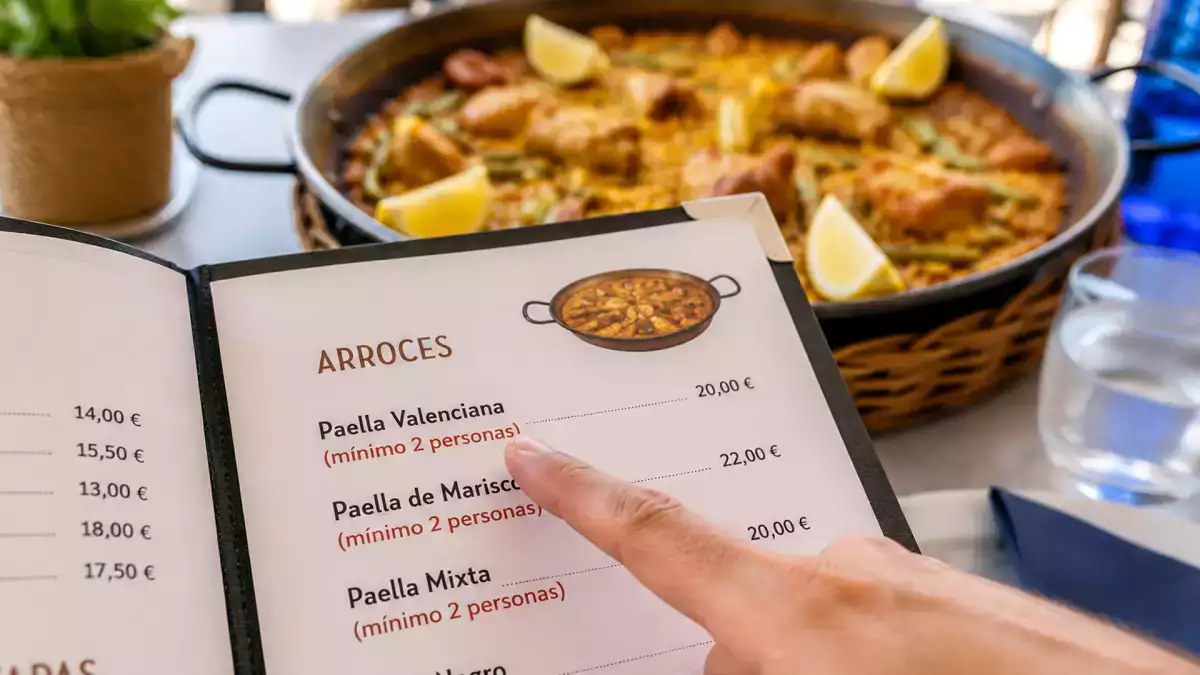
The scene is easy to imagine. Someone arrives at a restaurant excited, with one clear idea in mind: they want paella. But then they notice a small condition printed on the menu, usually in modest, almost administrative lettering: “Paella, minimum two people.”
And that is when suspicion appears.
Not a serious suspicion, not the kind that ruins your vacation, but a smaller, persistent, very human one: they’re trying to get me. Minimum two? Since when does a dish require company? Why can every other dish be ordered for one, but not paella? Is it tradition, or just a polite way to double the bill?
Excuse me, you ask the server, couldn’t you make me half a paella? A little personal paella so I can enjoy my rice while Carlos has his Spanish omelet?
The short answer is: yes, they probably could. Almost anything can be done in a kitchen if someone is willing to pay the price in time, space, and organization.
But the better answer is different: in most cases, behind the “paella, minimum two people” rule, there is not necessarily a scam. There is usually a mix of technical, logistical, and economic reasons.
The size of the pan, the rice, and the heat: the technical reasons
Paella is not cooked like a stew. It is a dry rice dish cooked in a wide, shallow pan. That means it needs surface area: the rice should be spread in a thin layer across the bottom of the pan, in contact with the heat, with enough space for the broth to evaporate evenly.
That is part of the problem. A paella for one is not simply a paella for two divided in half.
- If it is cooked in a pan that is too small, the rice layer can become too thick and lose the texture that makes paella what it is. Instead of staying loose and dry, it can become compact, unevenly cooked, and closer to boiled rice than paella.
- If the pan is too large for such a small amount, the grains can dry out too quickly or burn too easily.
Other things change too: the diameter of the pan, the intensity of the heat, the speed of evaporation, and the balance between liquid and rice. In cooking, scaling a recipe down does not always mean simply dividing the ingredients.
The socarrat: why it is harder in an individual paella
Then there is the socarrat, that thin toasted layer that forms at the bottom of the paella when the rice reaches the end of cooking and the broth has almost completely evaporated.
It is not just “stuck rice.” It should be golden and crisp, not burned.
Socarrat lives on a very narrow edge: one minute too early, it does not exist; one minute too late, it is burned.
To get it right, you need enough rice on the base, the right pan size, evenly distributed heat, and rice that reaches the end of cooking without turning mushy.
When the quantity is very small, as in an individual paella, that margin becomes even narrower. The rice can go from dry to burned much faster, making it harder to form an even crust without ruining the rest of the dish.
That is why many restaurants prefer not to offer paella in a single-serving format. It is not impossible, but it is more likely to come out uneven.
Why the kitchen matters more than the menu
Of course, the customer does not always have to think about all this. They already have enough to do reading the menu, wondering whether the house wine is a trap, and pretending they do not mind being seated near the bathroom.
But in the kitchen, the situation looks different.
Paella is not a dish that can be assembled in two minutes. It has to be cooked in the moment, in its own pan, over its own heat source, with someone paying attention so the rice does not overcook, stay hard, or burn.
That means that for much of the cooking time, one paella takes up burner space, requires room, and needs a cook’s attention.
So an individual paella can be inconvenient for a restaurant. Not because it cannot be done, but because it requires reserving space, heat, and attention for a single portion. During a busy service, that difference matters.
The heat has a cost too
From the table, a paella for one seems like a reasonable request. If it contains less rice, less meat, or fewer vegetables, it should cost less.
But the restaurant’s calculation does not work exactly like that. The amount of rice can be reduced, but the cooking time, the heat, and the attention required often cannot be reduced in the same way.
That is where the economic issue comes in. An individual paella can use resources similar to a paella for two, but generate a much smaller sale.
Rice is relatively inexpensive. Kitchen time, gas, stove space, and labor are not.
That is why “minimum two” is not always a polite way to double the bill. Sometimes it is a way to make the dish make sense within the real operation of a restaurant kitchen.
When to be suspicious of a “minimum two” paella
That said, just because there are technical and economic reasons does not mean every “minimum two people” rule is justified.
Some restaurants may use it as an excuse to sell more, or to serve a paella that does not really seem freshly made.
Sometimes, telling the difference is not easy. That is why it helps to pay attention to a few signs.
A paella arriving quickly is not automatically suspicious. A professional kitchen may have stocks, sofritos, and other prep work ready in advance.
What is more concerning is when that speed comes with rice that is soft, clumpy, too wet, poorly flavored, or looks reheated.
The two-person minimum makes sense when it reflects the real way the dish is cooked. It stops making sense when it is used to charge more, hide unclear pricing, or sell something called paella that is really just a dense, mushy rice dish with toppings.
Paella needs space to be paella
Maybe that is why the phrase “minimum two people” irritates us so much.
Because it does not just regulate an order. It reminds us that some pleasures still resist the individual portion, the exact calculation, the modern habit of serving everything in units of one.
Can there be a scam? Of course. There can be one almost anywhere the menu promises too much, weighs too much, and shows more photos than prices.
But paella for two, when it is well made, is not a trap. It is a requirement of the dish.
Or to put it another way: they are not always charging you more for nothing. Sometimes they are simply giving the rice the space it needs to be rice.
 Patricia González
Comments